Written by Raramai Campbell

Jamal Nungoh, is a member of the community based organisation Youth Voices Africa in Kenya. As a youth advocate he works in the Maasai communities that he is from as a peer educator to engage and mobilise young people, educators, community members and policy makers on the issue of period poverty and its impact on education, health and wellbeing. The Maasai are a semi-nomadic pastoral tribe that live in southern Kenya and northern Tanzania. Jamal’s advocacy work includes facilitating workshops, meeting with chiefs, providing free menstrual products and destigmatising menstruation all while navigating multilayered social taboos associated with gender, culture, ethnicity and menstruation itself.
I had the joy of meeting him at the Participate Youth Conference on social change and advocacy in Mombasa, Kenya last year. Besides being the tallest in the room (besides me!), he was dressed in a traditional shuka cloth with an array of colourful beadwork and spoke passionately about the work he does in the pastoral communities he comes from to combat period poverty. I found the stories he shared inspiring for many reasons because the act of talking about menstruation openly is important and brave, especially as a man in a conservative environment. I had the pleasure to link up with him again over a Whatsapp video call and talk about all things culture, menstrual equity and education. We also touch upon advocacy and his chicken coop start up, as well as the importance of getting men involved in the menstrual health conversation in Kenya.
I’m so glad we managed to finally connect! How are you, are you well?
I’m very well.
So I thought it would be good to start with introductions since I know you, but for those who don’t know you, who are you, what do you do?!
I’m Jamal Nungoh from Kajiado county. Kajiado county is predominantly a Maasai community, so they’re pastoralists, and herd cows, sheeps and goats. I’m also a volunteer and peer-educator at Youth Voices Africa. It’s a female led youth group that tries to do something for the community, because in Maasai communities, ladies are looked down upon. If a man is walking the streets of Kajiado, a lady has to be two steps behind him. You can never find a lady walking side by side with a man regardless of whether she is your mother, your sister, your aunt, daughter or cousin… So we give these ladies an opportunity, not only to lead a youth group, but to encourage them that they can do something for their community.
So how would you describe the work you do on a day to day basis, how do you do your peer education?
We try to mentor the young women and men, fortunately most of them are in school now, but for a long time the Maasai community did not value education. Now most of the girls and boys are going to school, at least to get their primary or secondary. Technology has also helped us a lot, we do posters and group meetings which we always share to spread the word via Whatsapp. We are lucky to have a strong network of people to rely on to help us sensitise young boys and girls. What we mostly do is start with prayers, then we see how they’re doing; have they had any challenges in school, what has and has not worked for them in that week. For girls mostly, it’s their menstrual health – it’s very challenging. You’ll find that out of a class of 50 students, maybe 15 are girls, that number is low, very low, and of those 15 girls, you’ll find that not all of them are there at any given time. One of the causes of this is menstruation, it’s still a taboo here.

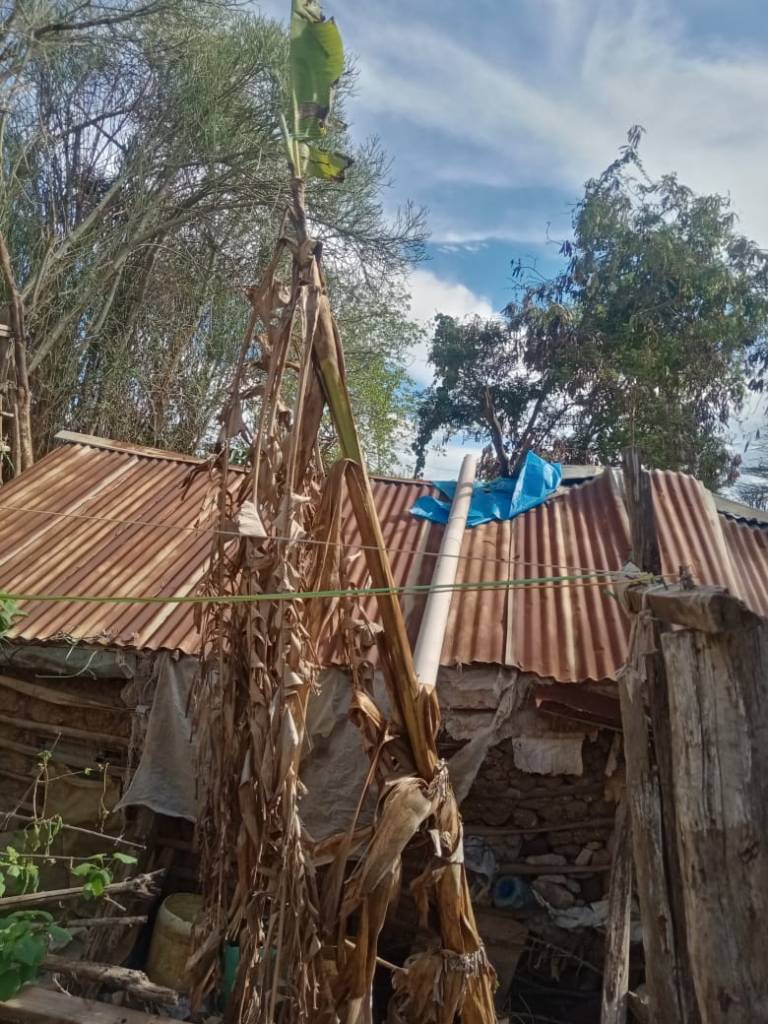
This is where my sisters stay when they’re having their menses. They aren’t meant to meet me or other men during this time according to Maasai culture because of the taboo. So that is one of the things we’re trying to address.
And as you can see here: a banana tree, you’ll find that in villages, this is one of the things girls use during their menses. The other thing girls use are cow skins or sand from the rivers – they sit on the sand and do their thing.

Do you also provide pads when you do your workshops and do you also talk about the health challenges of using sand, skins or banana leaves?
Yes, we talk to them and fortunately enough, there’s a community health worker that tags along when we have these conversations with the girls. She is a Maasai so people feel connected to her. She tells them about the bad effects of using these alternatives but the problem remains that they still don’t have sanitary towels.
You can talk about menstrual health but if someone doesn’t have the products…
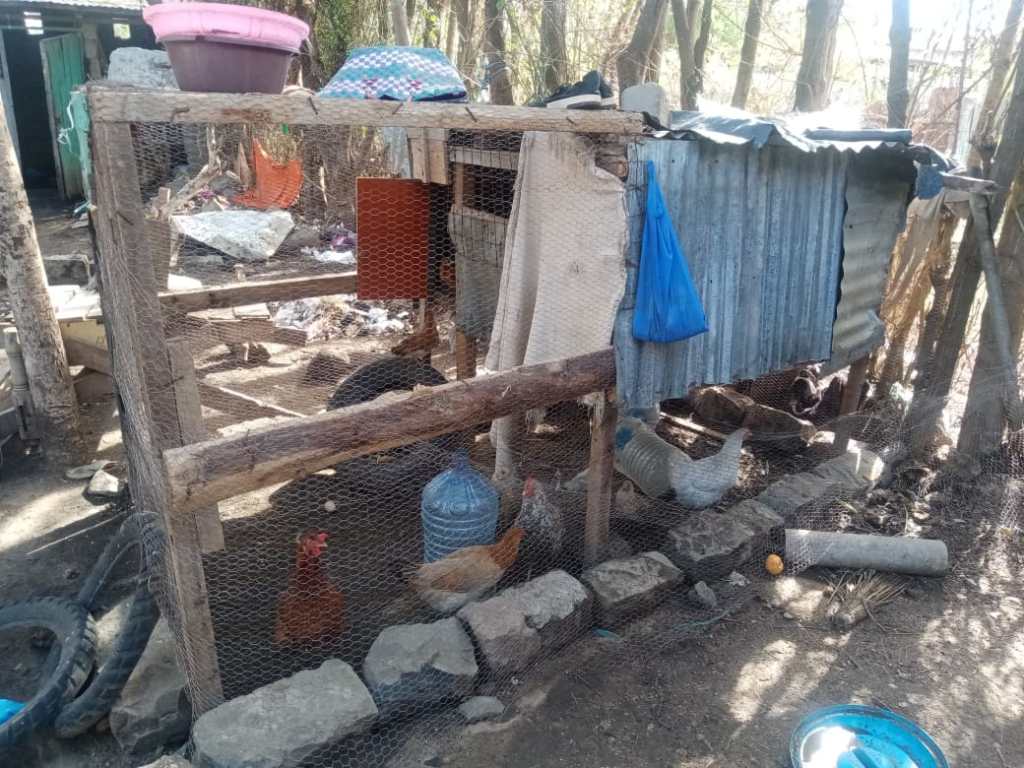
Exactly, so we came up with an idea. We started a project, just to help the girls. If I sell one of these chickens it goes for 1000 Kenyan Shillings, that is perhaps 50 sanitary towels for 10-20 girls. So I know at the end of the day if I have these chickens I’m sorted for the rest of the year. But there are still challenges because we want to increase the numbers of the chickens so we can sell more. These girls skip school everyday and they’re still expected to beat the boys at the end of the year in their national exams… So that is one of the things we’re really trying to do: keep them in school. Let them miss school because of school fees or uniforms but not because of this.
I agree with that, I support that. And then when we’re talking about involving men in the conversation, how do you fit that in?
It is working, the Maasai, there are chiefs and when he speaks, his word is final. So that is one of the things we do, but we also speak to elders, religious leaders, teachers, doctors, nurses. We showed the chiefs the effects of using sand or leaves, and then they got the idea – we also talked about how it’s a health hazard in other ways like snake bites.
Do you feel like the men getting involved have been receptive? That it hasn’t been difficult to start the conversation?
At first it was [difficult] because menstruation in the Maasai is taboo. Nobody wanted to talk about it.
Not even the girls?
It was embarrassing for the girls to talk about this with a man. Some of them would be walking and go ‘ah there’s Jamal, wanting to talk about menses’ (laughs).
‘Let me run?’ (laughs)
Yeah, yeah. So at first it was very difficult. It took a lot of time, a lot of convincing, a lot of talking to the elders. There was one woman who experienced FGM (female genital mutilation), who left the community, got a job as some communications director at an embassy, and came back: she had a big influence on the elders, telling them ‘there’s no need for that, I could have made it without the FGM, without being taken to these houses when I had my menses’. She spoke to the communities.
That’s really important, as someone who underwent it was able to be the spokesperson. Do you feel like across Kenya the conversation has started?
You see the likes of Atito, the Period Man doing wonderful work and even at schools, you’ll find everyone is talking about it. Even this chicken farm project would not have happened unless it was a problem and people were talking about it, but the problem is we’re not able to reach there yet, one step at a time.
Definitely, one step at a time. For your chicken farm, did it start from your own savings or was it part of the organisation?
It started from my allowance from the youth conference. It is only a 6 months old project, I also sell eggs and manure.
That’s really impressive and sustainable! On another note, what challenges have you come across?
Some of the challenges? Hmm, men will always be men, the way their mentality is means that some of them still don’t want to talk about it. You can send the chiefs, send the elders, but no… That is one of the challenges, there are some who won’t change, it’s perhaps only one or two in a group of a hundred.
One of the other challenges is that a father may give a mother 1000 Shillings for food, at the end of the day, he expects 1000 Shillings worth of food. If the woman buys sanitary towels and doesn’t buy the sugar for example, the men will ask ‘where is the priority: sanitary towels or food?’. So the prioritisation in the household is a challenge which means that even if you won’t find bananas you’ll always find banana leaves that they can use instead of sanitary towels.
That’s a very important perspective for people to know about… Besides those kinds of social and economic challenges, do you feel there are institutional challenges – at the schools or government?
There’s a policy actually, the government rolled out a program that all girls in primary and secondary school should get sanitary towels, but none of them are getting it, which means the money is being eaten by someone higher up. So that is a challenge, the fact that it’s there in policy and there is money put aside but it isn’t reaching the girls. Then at schools, sometimes there are cases where a girl soils herself, she won’t come to school the next day because she’s embarrassed. So besides providing sanitary towels, we try to address menstrual hygiene by discussing ‘how are you supposed to clean yourself, what are you supposed to eat, what kind of panties are you supposed to wear?’
I don’t know a lot about the Kenyan school system but I was wondering about sexual reproductive health in education? Is there anything during Biology class for boys and girls? What’s the situation?
Well there’s actually just been a politician here talking about wanting to pass a bill to outlaw sexual education in schools. Right now, it’s there but it’s limited. That’s actually a project we’re working on now. Recently when we visited a school, the headmaster refused. I was there personally, we’d written a letter and everything and he refused. He told us we can’t do this and we needed to go to a higher office, if they agree, you can do it. But it’s always hush hush with the Ministry of Education, they want you to speak to the girls and boys but there’s things they do and don’t want you to tell them like about LGBTQ.
How does your organisation, or you personally navigate that?
Quite fortunately, we have 2 avenues of our work; we have the talking in schools but also advocacy in the villages. The villages are good because we only need the consent of the parents and since they know us there, they don’t mind us talking to the girls about things like maturity, sexual health and intercourse but in the schools it’s a different story.
That’s good to hear! And on another positive note, what do you hope to achieve moving forward? Any big dreams?
One of the big dreams is to just get the girls in school. Let her miss school for anything else, but not because of menses. So one of the things I’d really like to do is to expand my coop to have not just 20, but 100 or more chickens so I can not only just pay school fees but also provide sanitary towels for girls in around six primary schools. It could be 50 shillings which may not sound like a lot but to the girls and the parents of the girls, it’s a lot. So I’ll do that as much as possible and consider getting a hybrid breed of chickens which grow faster that I can sell more of from my friend, Coaches.
It sounds like you have a really good network of people you can rely on when you need help?
Yes definitely, that youth conference we met at has really served me well. We’ve supported each other and gained a lot of perspective and experience from each other.
How do you feel like the menstrual health movement will move forward in the future?
I think it will get better with time because we have big plans for advocacy in the future like for Menstrual Hygiene Day – where we’ve reached out to some of the ‘big people’ and said “if you’re not giving us sanitary towels, can you show up to our event? Can you speak to the girls?”. Some of them have already replied very positively and said they will be there, in fact, you’ll find them at the school, they’re already there! (laughs).
We’re also working beyond menstruation to provide mentorship and talk about other issues in our community like mental health and drug and substance abuse. Some people from the community we work with have shared their success stories about what went wrong and what went right, like this man who was struggling with drugs and feeling isolated, who after a time, got sober and is now in a place where he is paying rent and has a family.
That’s inspiring. And in terms of getting young men involved in the conversation? Are they getting comfortable talking about menstruation?
Raramai, believe you me! The young men are talking about it, they want to be involved. In our group, as much as the leadership positions are filled by women, it’s the young men who say ‘I’ve got a motorcycle, I can ferry the sanitary towels or take you to the school for your event’. So, it’s the young men that are really pushing this agenda.
Okay wow, that’s really cool to hear…
Yeah, it really is. I think young people should not shy away from menstrual health and talking about this issue because I know that apart from the sanitary towels we provide, you can be walking down the street and a young lady or a mother stopping you and saying “Jamal, please, consider my girls”. Even though our target is to sell a chicken a month to pay for the sanitary towels, sometimes we must sell two or three to meet the demand. This is really important because there are many cases here in Kenya where boda-boda drivers (motorbike taxi) will tell a girl that they’ll buy her sanitary towels which costs around 50 Shillings if she agrees to have sex with him.
So now it’s sextortion to take advantage of the situation?
Yes exactly, so that’s why we try as much as possible to meet the demand. You realise that there are not many options for her so if you don’t manage to provide the sanitary towels, she’ll resort to the sexual favours option. That is why we appeal to donors for funding to try to meet the needs of at least 100 girls on Menstrual Hygiene Day by providing what we call dignity kits which have sanitary towels, panties, soap and tissues.
And perhaps a final question, I wanted to know about how the drought and water scarcity affected your work. Did you feel people were coming to you with worries about this?
Very much, fortunately enough we’ve had rain since!
Yeah, in the video you sent me, I could see it was properly raining!
(laughs) But yes, water has been a challenge. One jerry can typically goes for 10 Shillings, but when the drought came, the price doubled. Luckily, we managed to get donors from one of the churches close by when we were walking past, we saw them and we went “Muzungu – (white person) what are you guys doing here (laughs), and they said they were helping the church.” We explained that we were from a youth group and some of the activities we’d been doing and after some talking they agreed to sell us 2 jerry cans for 5 Shillings.
Ah, so they helped make it cheaper. That’s quite a big thing.
It is, you should have seen how long the line of jerry cans was! And the thing is that even the well dried up so there was no water. So we thank God that things happen miraculously. Now, things are okay.
Thank God for that and for people pushing the agenda. It’s very inspiring when you’re working with people and all going in the same direction. But thank you so much Jamal for sharing, really!
To keep up to date on the important work Jamal and Youth Voices Africa is doing, make sure to follow them on Twitter and Instagram!


Leave a comment