Written by Anna Thabuis with Ayan Musa Ahmed .
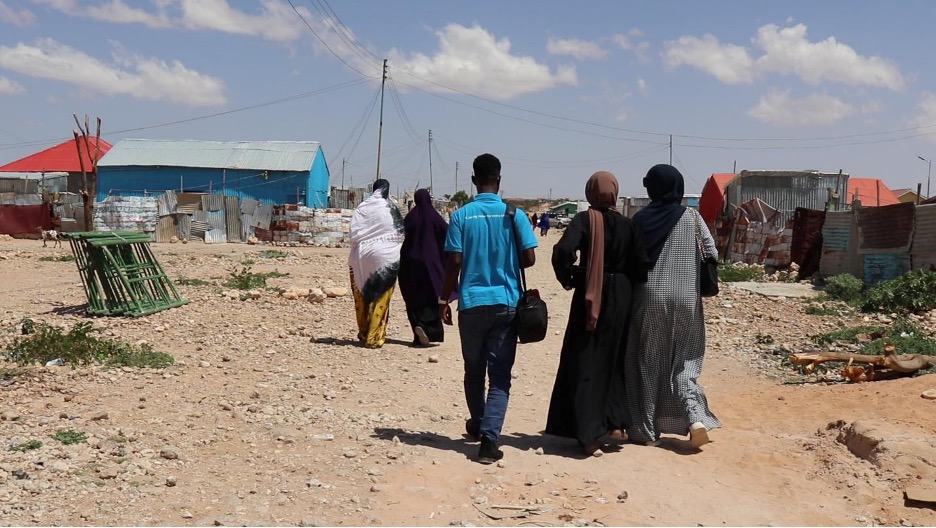
Ayan visiting an IDP camp. Photo provided by Ayan.
World Refugee Week has come and gone, yet it is crucial to continue the discussion surrounding access to care and refugee narratives. Today, Eye on Global Health invites you to reflect and celebrate the resilience, strength, and hope shown by displaced people – and the work done by those who support them.
Somaliland, a self-declared autonomous state situated in the north of the Somali peninsula, is home to 4.5 million people living in Somaliland, of which 35% are nomadic pastoralists, a form of pastoralism where livestock is herded to search for new pastures to graze on.
Conflict, political unrest, and environmental problems, such as persistent droughts that are exacerbated by climate change, all contribute to displacement and are particularly felt by the nomadic pastoralists. In metropolitan areas like Hargeisa, Somaliland, there are about 500,000 internally displaced people (IDPs). Many IDPs reside in either official settlements overseen by governments and NGOs, or in informal settlements. Urbanisation has also contributed to increasing numbers of IDPs, further straining resources and leading to overcrowded settlements with limited access to essential services.
One of these essential services is non-communicable disease (NCD)/chronic disease care. Although information about NCDs is scarce in Somaliland, it was reported that 7% of people there have a chronic illness. The most frequent conditions were blood pressure problems (41%), diabetes (19%), kidney disease (9%), and heart disease (7%). This high prevalence of NCDs in Somaliland, along with the high number of IDP’s, are
Between 2020 and 2023, Ayan worked to develop and fundraise for a pilot project to raise awareness of diabetes and enable access to diabetes care in displaced populations in Somaliland – her home country.
Today, I had the pleasure of sitting down with Ayan, a friend, colleague, and fellow Global Health student, to talk about her thesis and the importance of telling the stories of those whose voices are often stifled.
Can you tell us a bit about yourself?
My name is Ayan Musa Ahmed, and my story begins in Somalia in 1994. I was a child of six when the civil war displaced my family and me. We had to leave our home, joining the many others forced to do the same, not by choice, but out of a desperate need for survival. We made our way to Denmark, and in 2001 it became our new home.
The Somali-British poet, Warsan Shire, has a verse that speaks to the experience of forced migration: “No one leaves home unless home is the mouth of a shark…you only run for the border when you see the whole city running as well“. These words capture the harsh reality that pushed us to leave. But despite this, I also found an opportunity in my new home.
Denmark offered me access to free education, which opened doors for me. Today, I’m a graduate of Global Health and work as an Associate Project Manager at the World Diabetes Foundation (WDF). The journey from refugee to advocate motivates me to make a difference in global health.

Picture from Ayan and her twin’s 40th-day celebration, a traditional ceremony. Photo provided by Ayan.
Can you briefly describe your thesis?
My thesis focused on women’s experiences with diabetes in IDP camps in Hargeisa, Somaliland. The aim was to gain insight into how Somali women perceive and experience life with diabetes. In addition, I was exploring their access to diabetes care and the role of the community in their healthcare journey.
What made you focus on diabetes care and prevention amongst displaced populations in Somaliland?
I felt a strong personal connection to the region and its people. Also, NCDs like diabetes are often overlooked in humanitarian settings. The focus is generally on infectious diseases and immediate survival needs.
How I got to work with IDPs in Somaliland is a funny story – when I started working at WDF as a student assistant, I noticed a big map of the world in the WDF offices. It had many dots on many East African countries – but nothing in the Somali regions.
So, I asked the WDF’s managing director – why doesn’t WDF work there? He clarified WDF’s policy of not funding projects in regions with security concerns, which included Somalia. However, I knew Somaliland, a comparatively stable region, desperately needed support. After a few discussions, WDF started collaborating with SOS Children’s Villages (SOS CV) to establish a fundraiser project supporting IDPs living with diabetes and other NCDs. So, after a year of working on the fundraiser project, I gained substantial knowledge and established vital contacts in the region. This influenced my decision to write this thesis about IDPs in Somaliland.
Could you speak about the challenges faced while conducting research in a humanitarian setting?
The challenge in a humanitarian setting is the prevalence of multiple comorbid conditions. Almost all the participants had at least one more health condition: hypertension, gastritis, cardiovascular disease, and poor oral health, which acted as significant barriers to diabetes care and management. The high rate of comorbidities was unexpected and highlighted the complexity of healthcare in a displaced setting. Moreover, I was deeply moved to discover that many participants had lost a family member due to diabetes complications. This tragic reality had led to diabetes being associated with death, creating fear and stigma within the community, making it a topic people were reluctant to discuss openly.
While working on my thesis, I constantly had to confront and evaluate the power dynamics between myself and the study participants. As an employee of WDF, the organisation assisting these women, I knew they might feel compelled to participate in the study. It was critical to address this potential conflict of interest and ensure their voluntary involvement. To navigate this, I held detailed discussions with WDF, SOS CV, the Ministry of Health Development in Somaliland, and the Somaliland Diabetes Association, exploring how to prevent and manage potential conflicts of interest.
Moreover, throughout the research process, I was frequently faced with the ethical dilemma of narrating someone else’s story. How could I, in good conscience, present these women’s experiences in a manner that satisfied academic rigour and respected the perspectives of those whose lives I examined? The challenge of doing justice to their stories while maintaining an objective, analytical stance was a fine line to tread.
In his book “Culture and Imperialism“, Edward Said discusses the power of narrative, stating, “The power to narrate or block other narratives from forming and emerging is significant to culture and imperialism, and constitutes one of the main connections between them“. His words were a potent reminder of the narrative power I held as a researcher and the responsibility that came with it. Despite the inherent complexity of the process, my aim was to ensure that the stories of these women with diabetes were told with integrity, respect, and an acute awareness of the dynamics at play.

Entrance of the Malawle Camp, photo provided by Ayan.
Could you tell us a bit more about the camp you visited? What was day-to-day life like?
The day-to-day life in the IDP camps—Malawle, Ayax 1, Sheik Omar, Daami, and Nasa Hablood—I visited was greatly influenced by their geography and infrastructure. Most of these camps were in peri-urban areas, except for Daami. The residents had to grapple with poor road conditions and limited public transportation. These physical challenges posed significant barriers to accessing services and resources outside the camps.
Malawle is situated about 10 kilometres outside Hargeisa and is a beacon of resilience amidst adversity. Although the journey from the city centre was challenging due to poor road conditions, the vibrancy and organisation within the camp were palpable as soon as I arrived. Home to over 1,700 households, the residents lived in shelters built from a mix of brick, concrete, or steel, standing as a testament to their determination and the support they received from the government and NGOs like SOS CV. Established formally in 2019, Malawle was transforming from a camp focused on emergency assistance to one that encouraged the development of resilience.
Is there an experience that stands out from your time in Somaliland?
As for an experience that stands out from my time in Somaliland, it is, without a doubt, the interactions I had with the women participating in my study. Their strength, resilience, and generosity in sharing their life stories and experiences left an indelible mark on me: meeting Fadumo. She, like me, was displaced by the Somali Civil War and has spent her life navigating the challenges of displacement and diabetes. She turned to SOS CV for assistance and emerged as a leader within her community. She established literacy programs and small businesses, transforming the deprivation narrative into empowerment. Fadumo’s words, “Our potential is equal to everyone else’s,” have stayed with me, echoing the resilience I’ve witnessed in countless others.
One particular aspect I admired was the spirit of the Somali people, especially the women. They did not perceive themselves as disadvantaged or unfortunate; instead, they saw themselves as equal partners who could contribute to their community and society. This perspective is something that I carry with me, a reminder of their enduring strength and resilience.
What is the biggest lesson you learned whether professional or personal?
My interactions with the women participating in my study. Their strength, resilience, and generosity in sharing their life stories left an indelible mark on me. One participant, Hiba Suleiman, appealed, “My one appeal to you is for you to tell our stories – People should know we exist – let our voices be heard.” This powerful appeal became the guiding principle of my thesis and my motivation to bring their stories to the forefront.

Ayan and her sibling’ first day in Denmark in 2001. Photo provided by Ayan.
This year’s theme for World refugee day is ‘hope away from home’; what does that mean to you?
Reflecting on this year’s theme for World Refugee Day, “Hope Away from Home,” I saw hope manifested in many ways during my fieldwork. For the displaced individuals I encountered, hope was the courage to adapt, build, and grow even in new, unfamiliar environments. It was about finding strength in the community and supporting each other through shared and individual challenges. It was about creating a home away from home. Community-based initiatives, like the ones led by Fadumo, the head of the CBOs, played a vital role in fostering this hope. These initiatives, combined with financial support from projects like the WDF, address immediate health needs and empower individuals, giving them the tools and resources to improve their circumstances, effectively demonstrating that “Hope Away from Home” can be nurtured and sustained.
In your opinion, how can we raise awareness about the challenges to accessing care faced by displaced populations?
We can raise awareness through storytelling and advocacy. By highlighting the experiences and resilience of these communities, we can generate empathy and catalyse action from policymakers, NGOs, and the public. We must tell refugees’ stories. Stories like Fadumo’s are a powerful testament to the potential within displaced populations, and they need to be told.
The WDF Fundraiser project raised approximately 160,000 euros. Through the project, 14,000 people from Hargeisa’s vulnerable IDPs gained a greater awareness of diabetes, 655 persons with diabetes living in disadvantaged communities received improved diabetes self-management, and 150 health professionals, educators, and health organisations gained the capacity to inform and support vulnerable communities. You can learn more about this project here.


Leave a comment