By Anonymous, supported by Eye on Global Health

This article was originally written during the encampment organised by studerendemodbesaettelsen in May 2024 but has been adapted to reflect the statistics from January 2025.
Since October 7, 2023, there have been over 46,645 confirmed deaths, and 1.9 million internally displaced people, of which 90% are from Gaza. The genocide being committed in Gaza is a humanitarian crisis (1). 485 days have passed and we are still fighting for awareness, divestment and ultimately a ceasefire to stop the genocide. We, Eye on Global Health have been disappointed by the lack of accountability, and the involvement of institutions such as the University of Copenhagen with Israeli institutions and the Danish Government’s arms sales to Israel.
Before entering class, we walk past powerful messages written with chalk on the pavement, calling for a ceasefire. When we leave class we are confronted by empty pavements as the messages have been wiped away, as we hear the chants of our colleagues, “FREE, FREE, PALESTINE”. The solidarity and activism displayed by our peers remind us of the power we hold as students. Student organisations such as studerendemodbesaettelsen have provided a platform for awareness, education and actionable steps to call for a ceasefire, which the University and our lectures have failed to do. Despite attempts from students, there is a reluctance to discuss the genocide in Gaza in the classrooms of our MSc Global Health programme. It continues to be the elephant in the room that plays heavily in many of our minds.
We find ourselves left with more questions than answers when it comes to the applicability of what we are taught in class and how this translates to the real world. During our lectures, we learn about health promotion, migration health, health vulnerabilities, reproductive health and overall health as a human right. With these being the core components of our study, how can our classrooms and institutions ignore the current situation of the world? How can we learn about migrant health without mentioning the 1.9 million internally displaced people? How can we learn about health promotion without learning about how Al-Shifa Medical Complex, the biggest hospital in Gaza, is in no state to be used? How can we discuss reproductive health with no mention of the 50,000 pregnant women in Gaza facing malnutrition, dehydration and minimal access to obstetric care? All while the Israeli government blocks humanitarian aid from entering (2).
The situation in Gaza is a major public health catastrophe, and we are watching it unfold on our smartphones and pretending it doesn’t exist during our lectures.
Is this the so-called ‘critical education’ the university provides to Master’s students in Copenhagen?
During our introduction week, we were introduced to the concept of decolonisation, a term that has been used widely throughout the field of Global Health. Decolonisation in academia is the process of understanding how institutions, relationships and systems were and still are influenced by colonialism, and working towards eliminating this harmful legacy. By choosing to stay silent about Palestine we are contributing to colonial practices. During our lectures, we hear about research interventions in post-colonial countries, and how years of oppression continue to have effects generations later. We learn about how global health professionals can help and develop community-co-created interventions. In 40 years, will we learn about how global health professionals perform health intervention in Gaza the same way we learn about former health interventions now? But what about now? As the first phase of the ceasefire deal begins? As the genocide has created new health challenges and exacerbated previous ones…
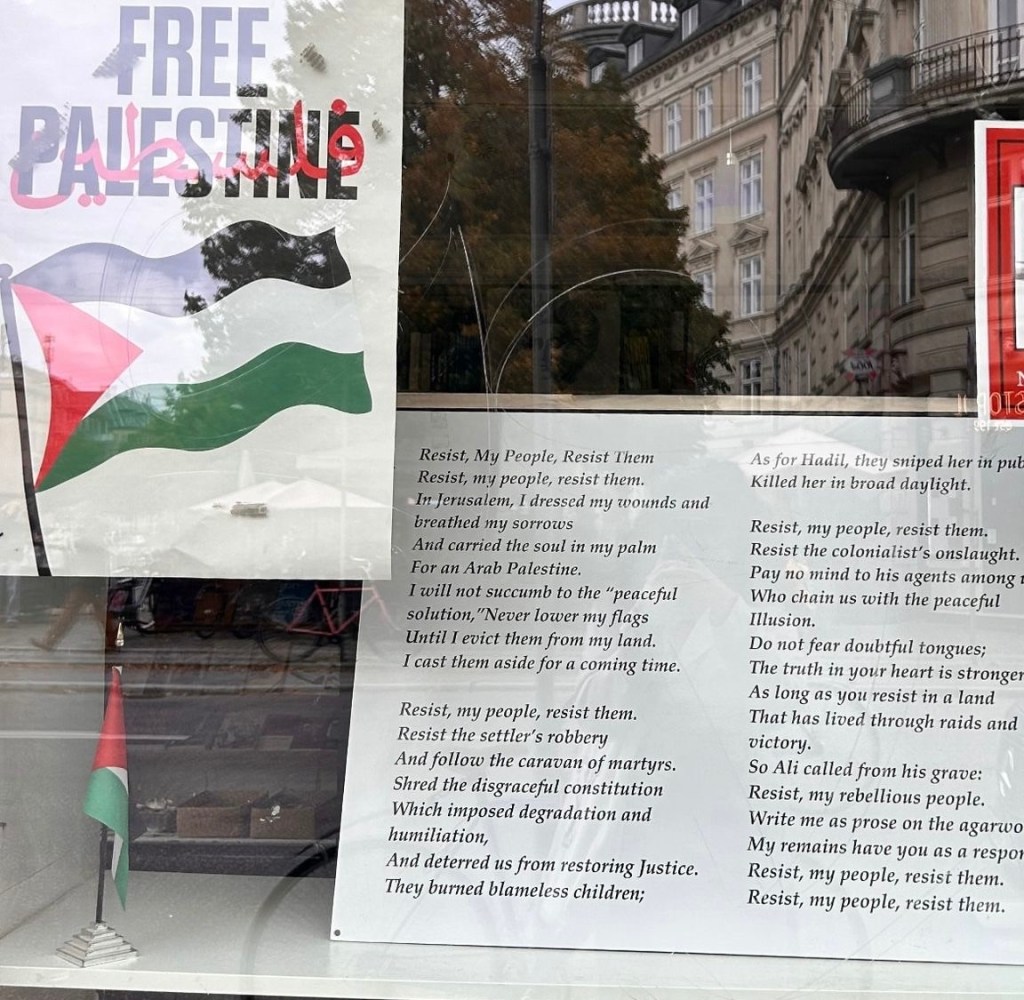
Image taken by the author – a poem on resistance
In the upcoming year, we as a student-led initiative want to continuously fight for conversations that are rightfully political, as we view this as our moral duty. Global Health is about health equity and justice. This includes health equity and justice for Palestinians. We do not want to be silent. We support our peers ‘studerendemodbesaettelsen’ and student organisations around the world. As students of this university, we can experience many privileges that many others aren’t able to experience. We can watch people from Gaza on our phones and switch it off whenever we want. We can continue to live a life and learn about global health while our counterparts in Gaza are facing starvation. As students, we have the privilege of choice to stay engaged and involved, and we need to use this privilege for good. Educating oneself, raising awareness and engaging in activism are some of the easiest ways we can do our part, and most importantly fight for the liberation of Palestine.
References
1. United Nations Office for the Coordination of Humanitarian Affairs – occupied Palestinian territory [Internet]. [cited 2024 Oct 21]. Home Page. Available from: http://www.ochaopt.org/node/10572http://www.ochaopt.org/node/10572


Leave a comment