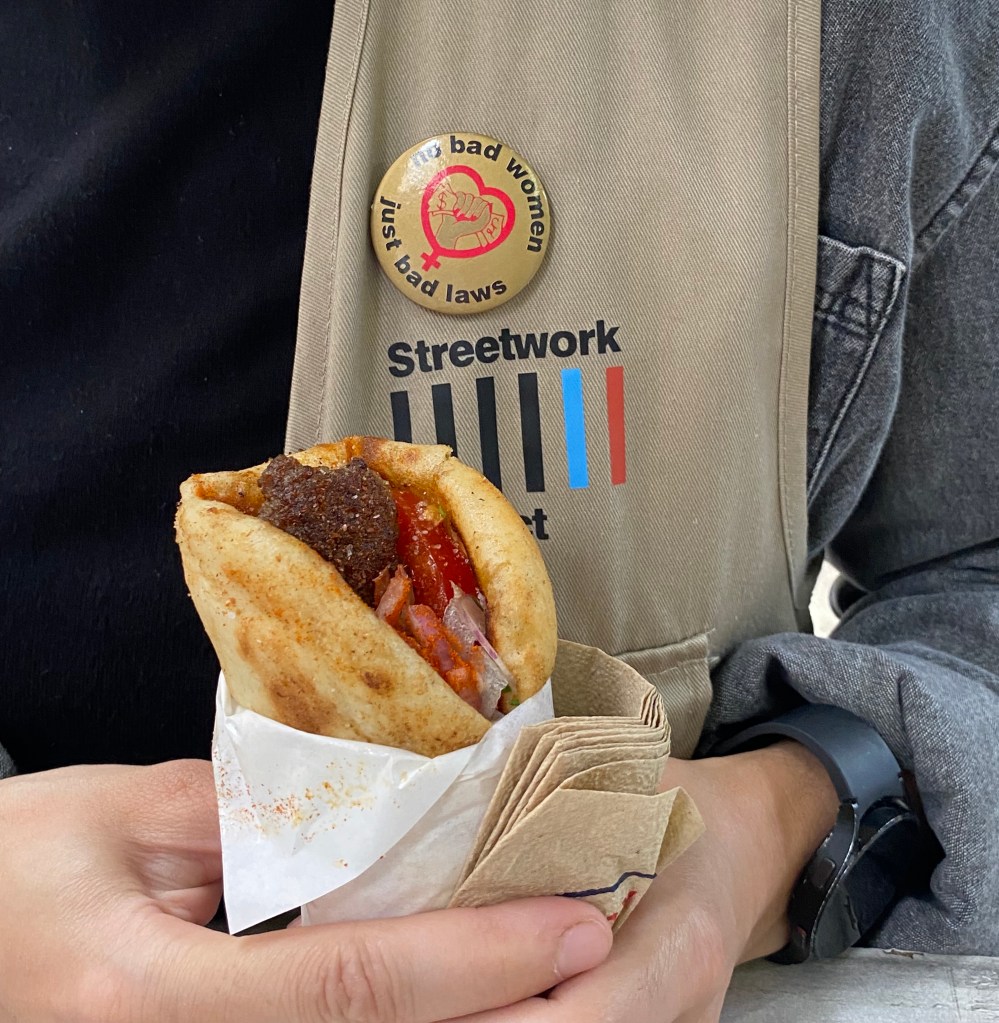
It is truly nice to revisit connections, even through a Zoom interview. Typically, on Wednesdays I used to meet Stavroula and the rest of the streetwork team, heading to the brothels in the center of Athens. We roamed around the area to offer protection, provide information and to promote the harm-reduction policies of Red Umbrella.
Red Umbrella Athens is a day center dedicated to the empowerment of sex workers. I began volunteering at Red Umbrella Athens, inspired by listening to daily life experiences of sex workers and conducting research on the challenges they face. Sometimes, after we were done volunteering, we would treat ourselves to souvlaki with the team. Yet, the true reward of volunteering wasn’t the souvlaki — it was the chance to connect with such inspiring individuals. That is why I shared a meaningful talk regarding sex-work with Stavroula Triantafyllidou, a psychologist, researcher, member of Red Umbrella Athens, and the ultimate gatekeeper of the best street food spots in Athens.
What do you think are the most significant factors affecting sex workers in Athens?
The first thing that causes the most damage and affects every aspect of sex work here in Athens is the legal model. European Sex Workers Rights Alliance (ESWA), in its most recent report (1) refers to the Greek model as a regulation model. This model allows sex work to be legal, but it is heavily regulated by the government. For instance, sex workers are required to undergo medical tests every 15 days, and brothels must be located at least 200 meters away from schools, churches, squares among other locations. In a city like Athens, which is densely populated, this makes it practically impossible for sex workers to offer their services legally. As a result, most sex workers end up working illegally, which is where the majority of the problems arise. Being illegal means they are mistreated—by customers, by their bosses if they work under management, and by the police. They constantly live in fear of being arrested, and not just arrested, but persecuted for being sex workers. The stigma and criminalization process make it even more difficult for them to live freely.
Another major issue is the stigma and discrimination that are tied to sex work as an identity. A lot of people don’t truly understand what sex work entails. They often assume that a sex worker’s body is there for the taking and that the client can do whatever they want. This assumption is completely wrong. There’s a clear discussion and agreement beforehand about the services that will be offered. Anything outside of that agreement is considered off-limits. If a client tries to push those boundaries, the worker has the right to stop the interaction immediately. But because many people don’t understand this, they often believe that they can do whatever they want to a sex worker. This attitude is not just limited to clients—it’s also ingrained in the stigma surrounding sex work in general. People often think it’s acceptable to treat sex workers this way, which makes the situation even more precarious for them.
What challenges do you think sex workers face when they are going to access the healthcare system?
What we have seen from both research and experience is that a lot of them, [especially migrant sex workers], have issues like language barriers. In Greece, it’s impossible to find someone to interpret in hospitals or in general public healthcare settings. So, the most common issue is the language barrier (2). They often avoid basic health procedures like smear tests. Instead, they wait until they return to their home countries to receive these services because they cannot communicate effectively with doctors here. This delay means they leave critical health concerns unaddressed, which can lead to serious complications in the future.
We’ve also seen that many of them avoid doctors because they’re afraid of stigma. They feel they won’t be able to properly explain the nature of their work to a doctor, who may judge or dismiss them, so they prefer not to go at all. There’s also the matter of trust. If you don’t trust the healthcare provider, you won’t disclose everything, and in some cases, many of them—we’ve seen this—are mothers. They are very afraid that someone will notify social services, putting them at risk of losing custody of their child.
What do you think about the intersection of the identities “mother” and “sex worker”?
This is a very, very sensitive topic for a lot of people, mainly because lots of people assume things we said before, they don’t know. They imagine a lot.
In the most recent conference we attended in Brussels, organized by the European Sex Workers’ Rights Alliance, there was a panel specifically about motherhood and sex workers from all over Europe. They discussed how many of them had lost custody of their kids simply because they were sex workers, often to fathers who were absent, had substance use problems, or other issues. The reason for losing custody, as they explained, was very clear and openly stated. It was even visible in the trial transcripts. The justification was based on assumptions that they would offer sex services with the child present. This idea is just… I don’t know where it comes from or who thinks of things like that, but people assume it.
Most sex workers—at least the ones we work with—are migrants and refugees. I’m talking specifically about sex workers in brothels and street-based sex workers, not those who work online. Most of them leave their kids back home. If they do have their kids here, they often prefer to work in the street-based sector because it allows them to make their own schedule. This way, they don’t have long shifts, like in brothels. But, as I said, most of them leave their kids behind and send money back home. This is because not only do their kids rely on them financially, but usually their older parents do too. The older parents care for the kids, and later, the kids take care of the older parents. So, that’s what we see most often.
If there was one myth you could make vanish about people who do sex work, what would it be?
Oh, I want more than one! And I’m not sure which one would be the most effective. What you said before really made me think. There’s this tendency for people to dehumanize sex workers because they don’t understand them, or how they do what they do. It’s beyond their conception of how someone could choose this work. And because of that, they tend to alienate them further by assigning them unrealistic and often very negative traits. They speculate about sex workers in harmful ways, like: “A sex worker? You can do whatever you want to her; she gets paid for it. If she has kids, she’ll provide sex services in front of them. Who would like to do that?” All these harmful stereotypes…
If I had a wish, it would be to stop this dehumanization. I would want people to be forced, in a way, to meet a sex worker, or at least to consider that they probably know someone who has offered sexual services—whether in their social circle or broader environment—but just don’t know it because that person hasn’t come out to them. So, yeah, I think that’s it.
Do you think that research conducted around sex workers has been tailored enough to address the needs of this group of people?
This is a good question. You know that at Red Umbrella, we often receive a lot of proposals from researchers wanting to conduct studies on sex work. I would say that 80% or even 90% of these proposals are ones we cannot participate in or agree to help. The reason is that most of them start from the wrong place: they begin with the curiosity of a researcher or a professor at a university about the stigmatizing fetish stuff or things they imagine about sex work. Their goal is often to answer their own questions, to make a fuss, to get published, and so on. What these proposals lack is a real connection with the community.
Recently, Red Umbrella participated in a feminist participatory action research run by the European Sex Workers’ Rights Alliance. They just published the policy brief—if you go to their website, you can see it (1). What’s important about this research method is that people from the community participate in the design of the research right from the very beginning. Together, they set the goals and focus on solving issues that actually matter to the community. This is what we at Red Umbrella try to do when we conduct research ourselves: we ensure that the goals and aims of the research are to help the community, not just to answer questions that outsiders have in their minds, questions like “Why would someone do this?” or inquiries framed in a psychoanalytic way that miss the point. They fail to listen to what sex workers themselves say to us every day. To do research like this, you need to have actually met a sex worker. The problem is, most of the people sending proposals haven’t. Their questions often come from their own curiosity or from other academic research they’ve read, studies that are also far removed from the community and aren’t participatory.
What traits do researchers need to have in order to work effectively with the sex workers’ community? For example, not just curiosity, but what else?
I think you need to have a strong relationship with the community itself. And I know that can be hard, but you personally know very well that if you go, put in the time, and are present consistently in the community and around it, people will eventually start to trust you. But at the beginning, they won’t. It’s very well deserved because of the way they’ve been treated—not just by society, but also by people around them, like their neighbours, police officers, and so on. Everyone is often very critical of them. So I think the first thing a researcher has to do is put in the time. I always tell people who ask me about conducting research that this process might take a lot of time because you have to earn their trust.
Another thing that’s very important to me is being able to give something back to the community for their participation in the research. That’s essential for many reasons. For example, when we participated in the feminist participatory action research, we compensated each sex worker with €50 for their time. It was an in-depth interview, and we discussed very sensitive topics, like trauma and how police had treated them in the past. These are incredibly traumatizing experiences, and it’s crucial to acknowledge their time and effort in revisiting them.
You also have to understand that you’re working with people who have been through a lot. Even if they want to help you, they often need to find some kind of justification for participating. You’ve seen this a lot at Red Umbrella. Many sex workers come to the day center to talk to us or to other sex workers, but they often need to justify it to themselves. They’ll say things like, “I’m here to get some secondhand clothes, shoes, pads, tampons, or whatever.” It’s a way for them to explain why they’re there without having to admit vulnerability—to themselves or others.
Finally, I think it’s very, very important for researchers to be sensitive and well-trained in all the intersectional identities present in the community. They need to be well-informed and inclusive about topics like LGBTQ+ identities, substance use (whether it’s problematic or recreational), migration, and refugee identities. These issues will come up, and if the researcher isn’t prepared, they could cause serious harm.
How disproportionate was the COVID/19 pandemic’s effect on sex workers in Athens compared to other people?
The impact was enormous. I started working at Red Umbrella right after the pandemic, when we restarted operating the day center. Before that, there had been a huge gap of about a year when the center wasn’t operating. During that time, the staff went out with vans and mobile units to provide whatever support they could out on the streets. But as you know, the police enforced strict isolation measures, which meant that even if sex workers wanted to work, they couldn’t. And you can imagine what that meant, because here in Greece, a large portion of sex workers don’t work legally. That means they didn’t receive any welfare, aid or financial support like other professions did. There was no safety net for them. At the start of the pandemic, many sex workers kept working because they had no choice—they needed to survive. But by the time restrictions tightened and they couldn’t work at all, things got even worse.
Most sex workers here in Greece weren’t trained or familiar with working online- as you know, there has been a huge shift in online sex work globally during the pandemic. So, without the ability to transition to online platforms, they were forced to stay at home. As a result, many sex workers accumulated huge debts during that time. Even when they finally went back to work, they had to work double shifts to try and recover financially. But that came at a cost, mentally and physically. You can imagine the toll this takes on someone’s body and mental health. Despite working so much, they couldn’t even cover half of the debts they had built up during the pandemic.
To make matters worse, by the time they returned to work, there were fewer clients. The market had shifted to online services, and they struggled to find enough clients to cover even the basics. The financial crisis still hasn’t ended. Just yesterday and the day before, I was visiting brothels in Athens, and many of the workers told me it’s the worst they’ve ever seen. At 7:00 p.m., they were already closing the brothels because there had been no clients for hours. Some sex workers left after servicing no clients at all for the entire day. You can understand how severe the problem is.
Is there any endorsement or new project you are embarking on at Red Umbrella?
That’s why right now we’re trying to find solutions. We’re talking with online sex workers who are experienced and willing to offer seminars and workshops to other sex workers. The goal is to help those who want to learn how to transition to online platforms and adapt to the changing landscape of sex work. This is one of our latest projects.
Oh, that’s so nice. It is so good to hear!
Yes, exactly. As you’ve seen, when the girls in the brothels aren’t working, they’re on their phones, often dressed for the job. It would be so much easier for them, during their downtime, to also engage in online work—whether that’s through funds or other means—if they were able to learn the skills. They can do it all just using their phones. So, it’s really about teaching them how to use the technology and the time they already have to create a new income source. We’re really hoping this will help them.
References
- ESWA. (2024, November 11). Policy brief | exposed from all sides: The role of policing … https://www.eswalliance.org/police_research_brief. https://www.eswalliance.org/police_research_brief
- Triantafyllidou, S., Siamitrou, P., Ntinopoulou, E., Apostolidou, A., Kouroupou, A., Kotsia, S., Papadaki, A., Papadopetrakis, G., Papastefanaki, K., Sougle, A., Tsiaras, V., Canellopoulos, L., & Poulios, A. (2024). Precarity Factors of Street-Based sex work within criminalised contexts: a study in Athens, Greece. Feminist Encounters a Journal of Critical Studies in Culture and Politics, 8(2), 39. https://doi.org/10.20897/femenc/14951



Leave a comment