
Ever wondered how your street address could be a secret key to your health and quality of life? Dive into this eye-opening article to uncover the ways your neighborhood shapes your well-being and life expectancy. From the air you breathe to the resources at your doorstep, discover how improving our communities can lead to healthier, longer lives for everyone.
The Impact of Neighborhoods on Health and Quality of Life
Where we live – the air we breathe, the water we drink, and our surroundings – strongly affects our health and can even change our DNA. Neighborhoods determine the socio-economic and environmental resources available to the people who live there. This has significant implications for differences in health outcomes, particularly impacting underserved communities around the world. For example, in the United States of America (USA), place of residence can limit opportunities for certain groups of people because they are poorly situated in terms of employment and other social resources. Poor neighborhoods are often characterized by exposure to toxic environments, such as air and water pollution, noise, and congestion, as well as higher rates of crime and violence. They also lack adequate recreational resources like parks and playgrounds, have unhealthy food chains, and failing schools (1).
Research has shown that various neighborhood characteristics, such as socio-economic status, environmental exposures, and the social and physical environments, significantly impact health outcomes. For instance, neighborhoods with concentrated poverty, limited access to healthy food, and higher crime rates tend to have poorer health outcomes and low quality of life. On the other hand, neighborhoods with better access to healthcare, green spaces, and healthy food options generally see better health outcomes and quality of life (1, 2).
Healthy Places, Healthy People
Healthy places and healthy people are highly connected. Neighborhood conditions affect health and quality of life. While some communities are overburdened with health risks, others enjoy abundant health-promoting resources, which in turn influence quality of life and health outcomes. For instance, living in a neighborhood with access to healthy food within walking distance can indirectly benefit your health, whereas living in a food desert (an area with limited access to affordable and nutritious food) can negatively impact your health (3).
Studies have found that living in a poor, deprived, or socio-economically disadvantaged neighborhood is associated with poor health outcomes, including higher mortality rates, poorer mental health, prevalence of chronic diseases such as diabetes and cardiovascular diseases, and adverse child health outcomes. For example, individuals living in neighborhoods with limited healthy eating and physical activity resources have a higher risk of being diagnosed with type 2 diabetes (4, 5).
Your Zip Code and Your Health
Minority groups and individuals with low income around the world have limited choices regarding housing and residence compared to their wealthier counterparts. This inequality dictates where people end up living and the resources they have access to, which in turn influences health outcomes and quality of life (6).
Researchers are finding health and life expectancy differences between populations that are much closer in proximity – for instance, in neighboring ZIP Codes (also known as Postcodes). Evidence shows that a person’s street address or ZIP Code (Postcode) can affect their health. An interactive map developed by the National Center for Health Statistics in collaboration with the National Association for Public Health Statistics and Information Systems, and the Robert Wood Johnson Foundation, allows you to explore detailed life expectancy estimates across the USA, down to the census tract level.
This situation is not unique to USA. In the United Kingdom, for example, neighborhoods with lower socio-economic status experience worse health outcomes, such as hypertension, diabetes, and mental health problems (7).
Additional Examples
In Glasgow, Scotland, there is a stark contrast in life expectancy between neighborhoods. For instance, life expectancy for men ranges from 66.2 years in Ruchill and Possilpark to 81.7 years in Cathcart and Simshill – a difference of 15.5 years. These neighborhoods are approximately five miles/eight kilometers apart. Similarly, in London, United Kingdom, traveling east from Westminster, each tube stop represents nearly one year of life expectancy lost, according to findings from the London Health Observatory, as noted by the World Health Organization.
In Richmond (a city in Virginia, USA) a similar situation exists. As illustrated by the map below, In Swansboro, life expectancy is 69 years, while in the neighboring Westover Hills it is 83 years – a difference of 14 years. These neighborhoods are less than three miles/five kilometers apart, yet the disparity in life expectancy is significant.
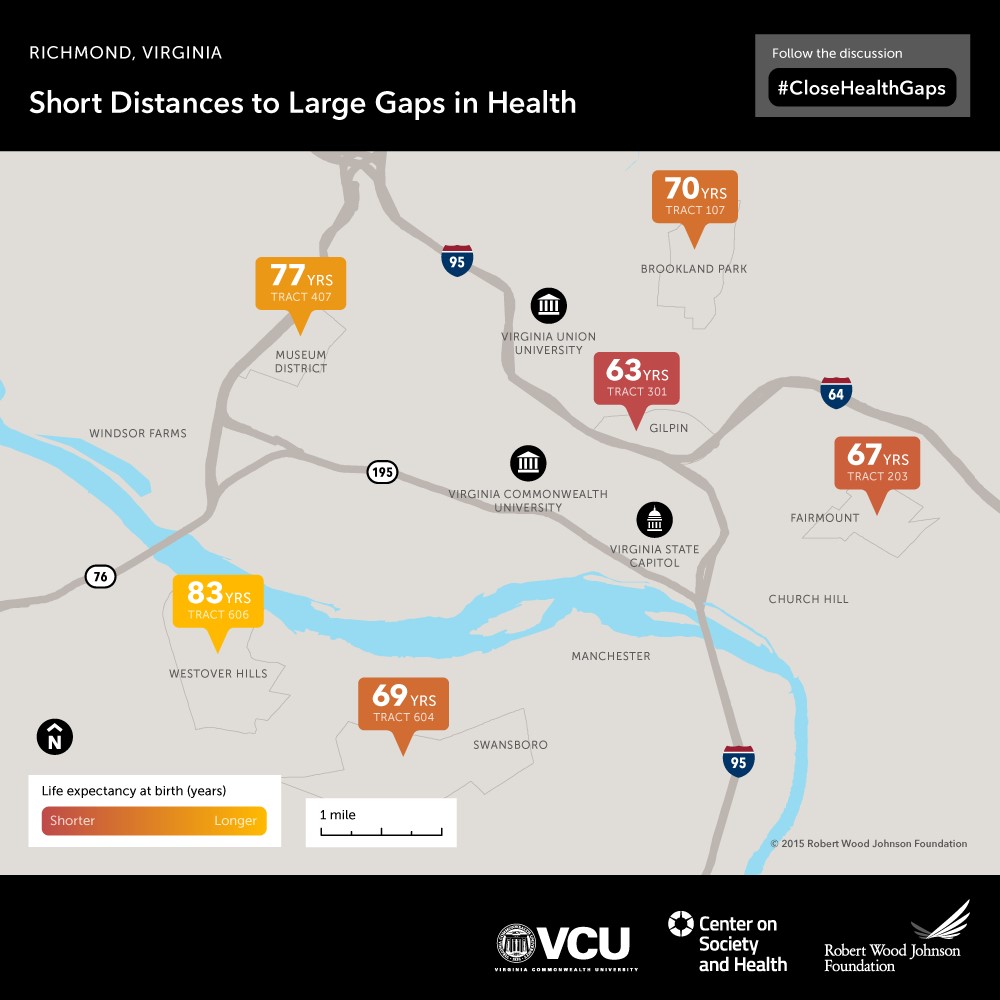
Photo Credit: Virginia Commonwealth University; Robert Wood Johnson Foundation, Center on Society and Health.
More specifically, this interactive online tool developed by the Robert Wood Johnson Foundation allows individual living in USA to compare the life expectancy in their neighborhood (by inputting their street address or Zip Code) with others closer or farther away within their city, town, or county. By typing in your home address, you can get precise average life expectancy for your own neighborhood. For example, the Cave Spring neighborhood where I live in Roanoke County (Virginia) has a life expectancy of 78 years, while a neighborhood in nearby Roanoke City has a life expectancy of 72 years, despite being less than five miles/eight kilometers apart. To see this for yourself, feel free to checkout the interactive tool to compare your address with other areas or compare different neighborhoods/street addresses if you live in the USA or have a friend or loved-one who resides here.
Who and What are Driving These Shifts in Health Differences?
Policies at the local and national government levels significantly contribute to the inequality in health outcomes related to neighborhoods, such as life expectancy. In Glasgow, the substantial difference in life expectancy between Ruchill and Possilpark and Cathcart and Simshill is influenced by several socio-economic and environmental factors, often resulting from policy measures like austerity (8). For example, Ruchill and Possilpark experience higher levels of income deprivation and unemployment compared to Cathcart and Simshill. Additionally, housing and living conditions, influenced by policies at local and national levels, can impact neighborhood health outcomes. Cathcart and Simshill have a higher proportion of owner-occupied households and better living conditions due to investment in their neighborhood, whereas Ruchill and Possilpark suffer from more overcrowded households and a higher percentage of people living near vacant or rundown land (9) due to a lack of investment by the public and private sectors. These factors collectively contribute to the significant disparity in neighborhood conditions and, consequently, poor health outcomes, such as life expectancy, between these neighborhoods.
Similarly, in Richmond (Virginia), local and federal housing policies, such as zoning ordinances and federally-backed housing loans, along with private bank loans, disproportionately affect disadvantaged neighborhoods and racial minorities, including African-Americans and Southeast Asians. Individuals in these neighborhoods often lack direct investments due to limited access to housing loans from government and private lenders/banks. As a result, people of color in disadvantaged neighborhoods have fewer housing options compared to their White counterparts, as they are denied mortgages and home improvement loans at twice the rate of those in affluent White neighborhoods (1). This results in substandard housing conditions in their neighborhoods, which in turn is detrimental to their health.
Conclusion
In a nutshell, where we live has a significant impact on our health and quality of life. Neighborhoods (even street addresses) determine the socio-economic and environmental resources available to residents, which in turn influence health outcomes and life expectancy. Addressing these disparities requires a comprehensive approach that includes improving neighborhood conditions, ensuring equitable access to healthcare, and providing resources that promote healthy living. By understanding and addressing the role of neighborhoods in health, we can work towards creating healthier, more equitable communities for all.
References
- Bullard RD, Johnson GS, Torres AO. Environmental health and racial equity in the United States: building environmentally just, sustainable, and livable communities. American Public Health Association; 2011 Apr. https://ajph.aphapublications.org/doi/abs/10.2105/9780875530079
- Mode NA, Evans MK, Zonderman AB. Race, neighborhood economic status, income inequality and mortality. PloS one. 2016 May 12;11(5):e0154535. https://doi.org/10.1371/journal.pone.0154535
- Elsayed O. The impact of environmental and neighborhood characteristics on physical and mental health. 2024. Available from: https://www.internationalhealthpolicies.org/featured-article/the-impact-of-environmental-and-neighborhood-characteristics-on-physical-and-mental-health/ [Accessed 5 Feb 2025].
- Christine PJ, Auchincloss AH, Bertoni AG, Carnethon MR, Sánchez BN, Moore K, Adar SD, Horwich TB, Watson KE, Roux AV. Longitudinal associations between neighborhood physical and social environments and incident type 2 diabetes mellitus: The Multi-Ethnic Study of Atherosclerosis (MESA). JAMA Internal Medicine. 2015 Aug 1;175(8):1311-20. https://jamanetwork.com/journals/jamainternalmedicine/fullarticle/2337256
- Adler NE, Prather AA. Risk for Type 2 diabetes mellitus: Person, place, and precision prevention. JAMA Internal Medicine. 2015 Aug 1;175(8):1321-2. https://jamanetwork.com/journals/jamainternalmedicine/article-abstract/2337252
- Diez Roux AV, Mair C. Neighborhoods and health. Annals of the New York Academy of Sciences. 2010 Feb;1186(1):125-45. https://doi.org/10.1111/j.1749-6632.2009.05333.x
- Gondek D, Ning K, Ploubidis GB, Nasim B, Goodman A. The impact of health on economic and social outcomes in the United Kingdom: A scoping literature review. PLoS One. 2018 Dec 31;13(12):e0209659. https://doi.org/10.1371/journal.pone.0209659
- University of Glasgow. UK austerity policies led to a decline in life expectancy. 2024. Available from: https://www.gla.ac.uk/explore/glasgowsocialscienceshub/resources/all/headline_1132401_en.html
- Understanding Glasgow. The Glasgow Indicators Project. Available from https://www.understandingglasgow.com/profiles/neighbourhood-profiles/nw-sector/ruchill-and-possilpark




Leave a comment