Anna studies Public Health Science (Folkesundhedsvidenskab) at the University of Copenhagen and was one of 15 students participating in an innovation project course including a trip to Kenya. In an interview with Marieke from Eye on Global Health, she talks about her experiences and reflects on the international collaboration.
Which case did you work on? Please describe what challenge you were trying to address.
I worked on the biogas case, which is a solution that uses human waste – it could also be animal waste or kitchen waste, but in this case it is human waste from toilets – and turns it into a gas that you can cook with. This makes toilets more accessible and also provides a cleaner cooking fuel than, for example, charcoal or kerosene, which are very commonly used in Kibera in Nairobi. Biogas has been introduced in Kibera several times, but these were NGOs coming in and building facilities and not really considering design or usability. Maintenance also hasn’t been a priority, so when the NGO left, sooner or later the biogas facilities fell into disrepair. In contrast, our partner organization 100% for the Children had been in contact with a school in Kibera, Ayany Primary school. The school wanted to have a biogas facility to be able to heat up food and also as part of their menstrual health programs, so they could sterilize menstrual cups. So it was sort of a combination of two projects, which was very exciting!
They’ve almost finished building the biogas facility there, and now we were supposed to collect data on people’s views on biogas in Kibera, because of course using human waste doesn’t sound great. In our case description we were told that it was very stigmatized, that people really, really didn’t like it. Of course we did not talk to everybody in Kibera, but we were surprised that most people we did talk to were quite open to the idea. Because when they learnt that it was a cleaner option, they were thinking: “Well, I know that the charcoal I’m using isn’t good for my health. I can feel it, I’m coughing, I’m having all of these health consequences. But it’s the cheapest option. And if biogas could be cheaper, then I would be very willing to use it.”
We also learnt a lot about the barriers that previous biogas solutions came with. For example, they required a lot of time to use, because the facilities were not in your own home, so you had to go somewhere to use the toilet. And then you also did the cooking at that facility, actually standing inside the toilet building, which of course is not a great experience while cooking, so there were some design flaws. Cooking also takes up a lot of time, and doing that outside your home is impractical: You cannot leave the cooking alone because something might happen to it, while if you are cooking at home you can do other things. You can fold the laundry, you can take care of a crying child and so on. So there were a lot of impracticalities with the solutions that had existed previously.
Our case expert, the technician who built the facility at Ayany, hopes to one day pipe the biogas into people’s homes, so that moving from your home to a biogas facility would not be necessary. You could have a compound with shared toilets where you pay money for the maintenance of the toilets and the biogas. That would be a more sustainable solution. Right now though, the focus of our case is to use Ayani to sensitize people to biogas and see if they are willing to use it. In the future they hope to be able to pipe gas from Ayany to nearby households. Selling the biogas would be an economic benefit to the school and they could then make other things cheaper for the families, so that more children could go to school. So all around a great idea.
This sounds like you are touching on multiple sectors at once. You are doing a health project that is to do with human waste management but also touches on menstrual health. You are also working with access to clean cooking fuels and improving respiratory health, improving access to energy, and possibly the financial situation of a school…
Yes. It’s a lot of things (laughs). If this project succeeds, it holds a very multi-factorial set of benefits. You could give the school access to cheaper fuel by subsidizing charcoal, but that doesn’t address the health problems. It’s not a very clean fuel – we want to use clean fuel in general, we don’t want to use charcoal for climate reasons, and places like Kibera are very affected by climate change. So we want to support the options that will help the community to mitigate climate change in the small ways they can. And biogas also means that they will have cleaner air and be able to clean their menstrual cups at school and have a hot meal at school, which would enable them to feed more families. You’re entirely correct, it’s focused on a lot of different things.
What would you say is at the centre of it all – the central challenge, the main issue?
One of our findings was that many people said they were a little sceptical, and that it didn’t seem right that you could cook with something coming out of a toilet. One person we interviewed told us that “It sounds great that we can turn waste into value, but how does it work? I would need to see how it works.” So the big challenge is in showing people how it works. They’d be very willing to use this solution if it’s cheaper and available – which it isn’t yet, but they’re also a little sceptical. So we would need two legs to stand on: availability and also an explanation. People know that poop isn’t great for them, so they wonder why you would use it to cook. There are also some questions around biogas itself, like: Does it smell when you cook with it? It does not, it’s no longer human waste, it is a gas that is odourless. Or: Does it take longer to cook with? Things like that. There were for example some people who were asking: Does the food taste different? Because they knew that if they used kerosine rather than charcoal, the food tasted worse, so they wouldn’t want to use the new fuel if the food tasted bad.
Another challenge, if piping becomes a reality in the future: We talked to a family where the mother was considering switching to a different type of gas, and she said “I’ve been thinking about it for a while. It would be cheaper for me in the long run, it would really free up a lot of money, but it’s a big investment, because I have to buy these burners which are different from the little charcoal ovens.” In the long run, if people are to be able to use biogas in their own homes, they need to have access to new equipment and they would have to know how to cook with biogas. And that’s what our suggested solution wants to address, using Ayany as an information hub where the parents can come and learn about biogas and where children will learn about biogas in their classes.
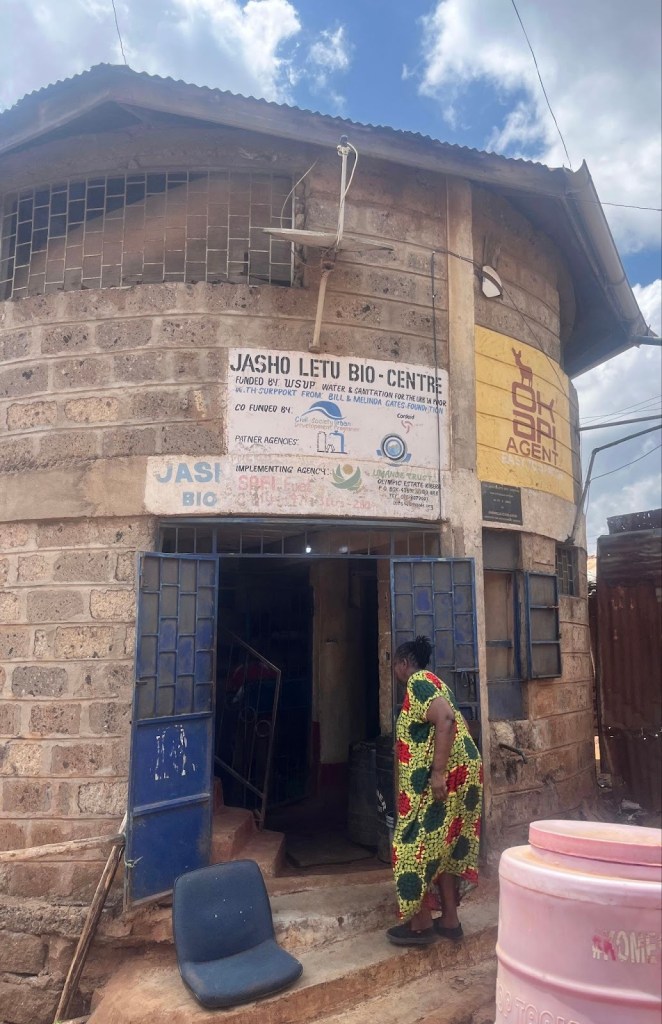
Image: a biogas facility in Kibera
What did you learn from being a part of this project, not just travelling to Kenya, but also working together with other students and the engineers?
One thing I didn’t mention earlier, which I think was a key learning, was the importance of community ownership and listening to what people need. We had a focus group discussion where we asked, very broadly, “What do you think should be done to spread knowledge and acceptance of biogas?”, and there was a suggestion that the name should be changed to a Swahili word so that it’s more localized. Because of course biogas is an English word, and although people speak English, “it doesn’t really tell you that this is something we have here in Kibera, that this is ‘our thing’.” They suggested the name Hewa Safi, which means “fresh air”, which presents the benefits of biogas and sort of rebrands it, taking away the focus on the stigmatized bodily waste and focusing on the benefits. My point is that we would never have known this or thought about this. Of course, the entire time we wanted to make this something the people of Kibera could be proud of. But if we hadn’t listened, we would never have known that this could be done by giving it a positive name in Swahili. Of course this feels very, duh, of course, when you’re doing qualitative research your whole point is to listen to people! But I think it really went into my heart how important community ownership and listening to communities is.
What we want to do for our project is an information campaign at the school where people can learn about biogas, and we’ve been getting more context from our case expert about how things work specifically in Kibera. Which of our suggestions are very Danish and not very viable in Kibera? Which are great? And which are things we hadn’t even thought of? The technician mentioned for instance that there could be a demonstration at a science fair. I’ve never been to a science fair in my life, but they apparently have lots of them at their schools, so that’s a great way to include biogas – they can demonstrate it, the children can cook on it and so on. Community involvement has really been a key takeaway for me through participating in this.
Did you have any challenges? Also, now that you’re talking about listening to people: Were there people you feel were not included?
For sure. We did talk to a lot of very vulnerable people living in varying degrees of poverty – of course there might be some people in vulnerable situations we just didn’t have the opportunity to talk to. But there’s actually also the fact that we didn’t talk to people with power in Kibera. That was originally something we were going to do. I was personally really excited to talk to a religious leader, because Kenya is a very religious country and I was wondering if there were any possibilities to reframe the “filth” of using human waste. Is there anything in the Bible or Quran about using what you have and circular thinking and could we in some way work together with these religious leaders to introduce this to people? We did talk to some people who said their religious leaders would be supportive of it, because they support people having better health, but I would have loved to specifically talk to religious leaders. We also did not talk to anyone with substantial political power. We did not talk to any chiefs or anyone under the chief. Some interviewees also mentioned that powerful actors in Kibera are invested in charcoal because of charcoal stand owners paying them, whereas biogas is more community owned. You are not going to run out of human waste to turn into biogas as long as there are people living in Kibera. Of course maintenance is necessary, but the core resource of human waste is going to be there, whereas charcoal is something you have to bring in from outside Kibera. So I would have loved to know more about this corruption. There was also the problem that we really didn’t get to know the power structure of Kibera very well. We were often asking, “What do you do about this? Who do you talk to about this?”. And of course none of the structures are legalistic, it’s not a politician you vote for, but rather based on trust and personal relationships. It’s also different in the different villages of Kibera. So we had lots of questions on how things would be handled. We had two weeks, so we didn’t get to see everything. I think we are missing some things from the top and the bottom, but we have people in the middle we could talk to.
You just said you only had two weeks and that you could not see everything. Was there ever a point where you questioned how you were doing this project, or how this whole course was set up? Where you thought, “maybe we are doing this the wrong way?” If so, when did that happen and why?
My case group has two anthropologists, and for them this would have been a six month field work project. It should have been so much longer, and I agree with that. Of course we would have learned so much more and we could have gone more in depth. There was a central problem of “do we just not have the time to learn enough?” But of course even six months is too short. Nothing is ever going to be enough to understand true, lived complexity, in all these situations when you come in as a newcomer. I’m very white and I’m coming into this community as a complete outsider, they might think, “you don’t belong here.” I did gain some trust, by coming through a university and with 100% for the Children, who have been in Kibera for a long time. We would never have been able to interview people if we didn’t have a bit of trust. I think the main thing I thought was that there just wasn’t enough time, we’re never going to know enough in two weeks. But again, if we’d had six months it still wouldn’t have been enough, it’s just such a complex thing. I think I’ve just had to make my peace with the fact that no solution will be absolutely perfect and make the lives of everyone at Ayany school better, because we just don’t know enough. There will be pushback from leaders we can’t predict or some underserved communities within Kibera we can’t reach, because we don’t even know about them. I think that’s something I really thought about a lot.
We also reflected a lot in our group on the fact that our case is sort of two-sided: it’s both focused on Ayany school as it is now, but then also the possibility of future projects and how to sensitize people to biogas – wiping the slate clean from unsuccessful attempts and getting a fresher version of biogas into their minds and hearts, making it possible for them to use it in the future. We were struggling with that two-sidedness, wondering which one even is the point and which one to pick. But I think in the end we just said we had to do both. We had to think both about right now and about the future.
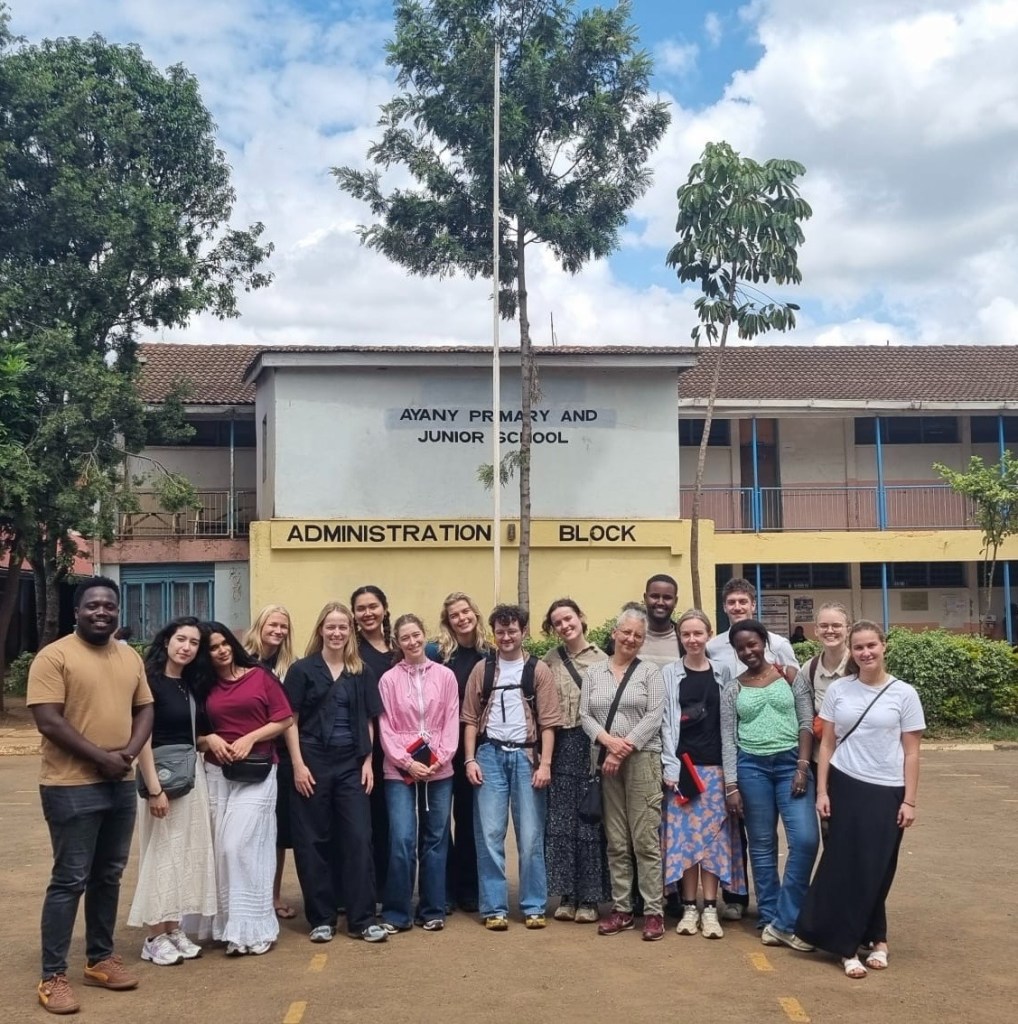
Image: Students participating in the health innovation project in front of Ayany School
That does sound challenging, even just on a technical level especially if you have a very short timeframe. To ask provocatively: You said that even if you had come for half a year, you would never understand the local context fully – of course, because you haven’t lived there for all your life. Are a group of Danish students even the right people to address this problem?
That’s also a big question. Of course I do think getting very different perspectives on something is useful, and getting someone from a country with an entirely different system can mean that you see things that you maybe wouldn’t see otherwise, if you just accept that this is the way things are done in Kenya. But it does also mean we don’t understand the context. It’s difficult to decide whether people from Denmark should be the ones doing this, but I do think we should have people from the Global North collaborating with people from the Global South. But if that’s what you want to do, it has to be real collaboration. It can’t just be people from the Global North coming in and building a facility without taking the local context into account, not talking to local people about what they need. Like they did with the existing biogas facilities, thinking “we need to make sure it’s pay-for-use so we have a budget for repairs and maintenance and people are able to use it in the future” but not really considering if people find the facility’s design valuable and necessary for their lives, whether it provides something for them in daily use. It needs to be centred around the communities in the global South and not around what would make people from the global North feel better.
I have one final question, but wanted to ask a follow-up question first: You talk about collaboration, and you’ve met a lot of people in Kibera. What problem in Denmark would you like their input on? It can be one specific person, the engineer you talked to, a focus group participant who stayed in your mind…
That’s a great question! I think our technician actually – he worked on the Human Needs Project in Kibera as well, which is a house where you can go and use the toilet, take showers, get your clothes washed, and he did a lot of really innovative thinking. He put up solar lamps along a really long street so that women could go to the market in the mornings and children could stay longer at school, because now you didn’t have to worry about it being dark when you left your house. Of course, you’re asking me on the spot, so I don’t really have a specific problem in mind right away, but just having a completely different mindset, coming from a different culture, seeing things in a completely different way… For example, I wouldn’t have thought about how much the solar lamps would change people’s lives! I knew that in Denmark, washing machines really changed women’s lives when they were invented. Our technician told us that it was similar in Kibera: Before washing machines, the people who were using the Human Needs Project earned about 1.5 dollars a day and now they earned about 2 dollars, just from freeing up that much time because they didn’t have to wash their clothes. So they actually earned more money, even though they were spending money at the Human Needs Project to wash their clothes.
We also went to the university of Nairobi and met some really innovative students. There was one student who was making prosthetics for amputees, and he was 3D printing those and making them cost half as much as a prosthetic would in the global North. I was thinking, “That’s the type of thinking we need everywhere.” I think I saw lots of examples of thinking that could help different problems. The very different culture and mindset can be helpful in collaboration in general.
Then I have one final question for you, and that’s about the most rewarding thing about being part of this project so far. Something that surprised or motivated you, that you felt was a very positive experience.
I have two, if that’s okay. It was very rewarding and touching for me that the people of Kibera opened their homes to us. We could go into their houses and interview them and they were so willing to sit and marinate in their thoughts for us and to show up to focus group discussions. It was very warming to feel that welcome and their openness to talking about these things. To get the privilege of seeing their lives, which I know are very hard and tough – they spent time they could have used elsewhere on us and I am so grateful they did. I don’t want to underestimate how rewarding it was for us, and hopefully we can give something back to them.My second one is actually our technician, because he’s such a passionate… ildsjæl is the word in Danish, fiery soul. He’s so passionate about this project. He’s a third generation Kiberan man and he’s saying “When I imagine the future of Kibera, it will be so different. We’ll be able to cook with biogas and have clean air in our homes and flying toilets (plastic bags used as a toilet and then thrown away) will be a thing of the past.” He has a vision for the future that I find really inspiring. I think a lot of people of Kibera also have this pride in who they are and where they come from and this vision of a future that doesn’t take them away from Kibera, but lets them stay in their communities and make them better by reducing the poverty that is a main part of their life right now.



Leave a comment