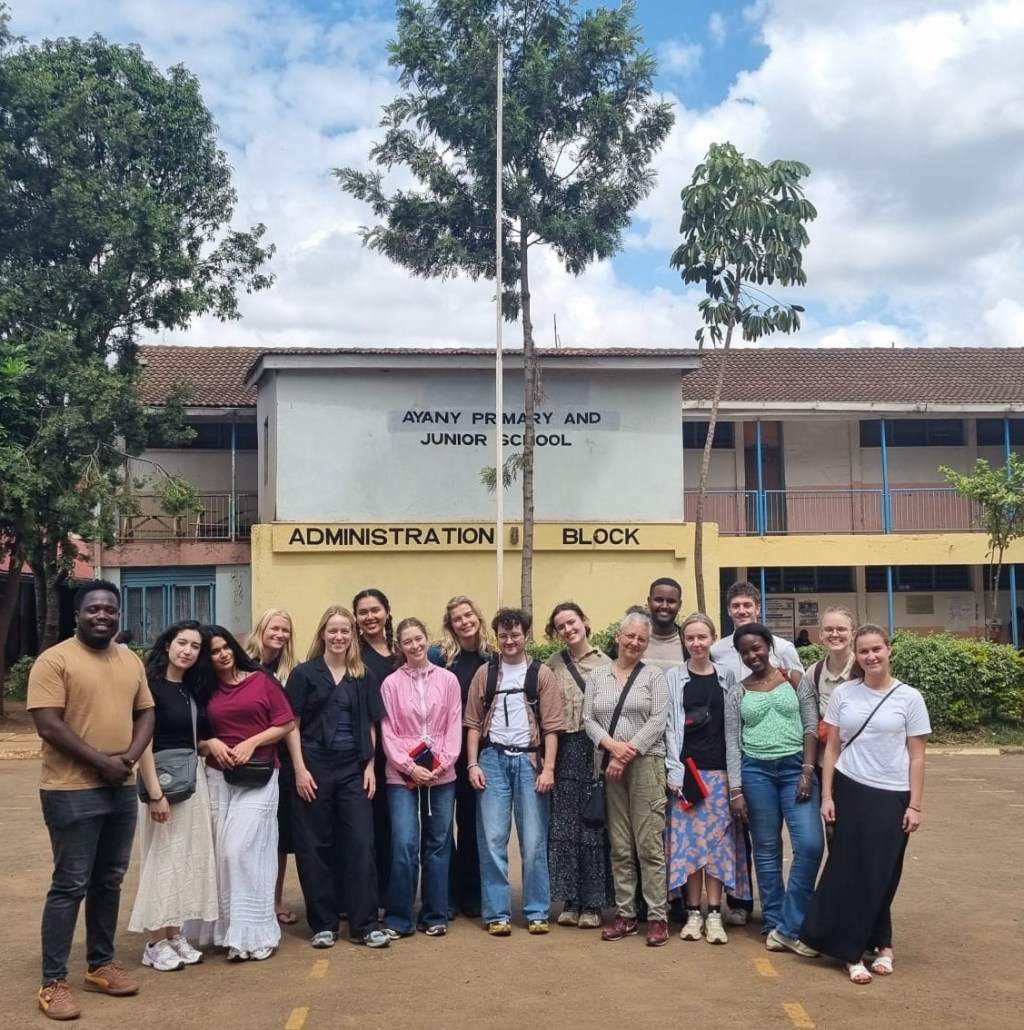
Vanessa is a law student currently doing her masters at the University of Copenhagen and was one of 15 students participating in an innovation project course including a trip to Kenya. In an interview with Marieke from Eye on Global Health, she talks about her experiences and reflects on the international collaboration.
What brought you to this health innovation project, if you are studying law?
I really like health and have had health law as a subject as well. But I also read about some of the cases and the UN goals this program wants to achieve, so I thought it would be nice to contribute with a law aspect as well and see what I can do to help, because it was so interesting on a personal level. I thought it was a very important subject and I just wanted to see if I could help in my own way.
That sounds interesting! So, which case did you work on?
I worked on the menstrual health case, which addressed how girls and women can get access to reusable products. Many girls and women lack access to affordable menstrual products, and that’s not the only issue – they don’t really have clean water either, so hygiene is also a problem. There’s also a lot of stigma about menstrual health. They don’t want to speak loudly about it, they don’t feel safe when they need to change their pads in public bathrooms, so it’s also a safety issue… There’s lots of different issues underpinning our case and we tried to solve it as best as we can with our solution. Hopefully we can do something about it, because it was very eye-opening to see and talk with the girls and women about their struggles.
So you are faced with the issue of people not having access to menstrual products for a variety of reasons – not having money to afford them, or lacking the facilities and the clean water to perform proper menstrual hygiene, and also stigma which might make it harder for people to know which products even exist?
Yes. Also, some girls have heard about reusable pads, but the thing is that you have to wash them and to dry them you need to put them out in the sun to dry properly. And a lot of girls didn’t want to do that, because they feel shame about their period or their menstruation, so they don’t want to hang the pads out to dry and would rather use a disposable pad so they’re free of that stigma. Especially the younger girls.
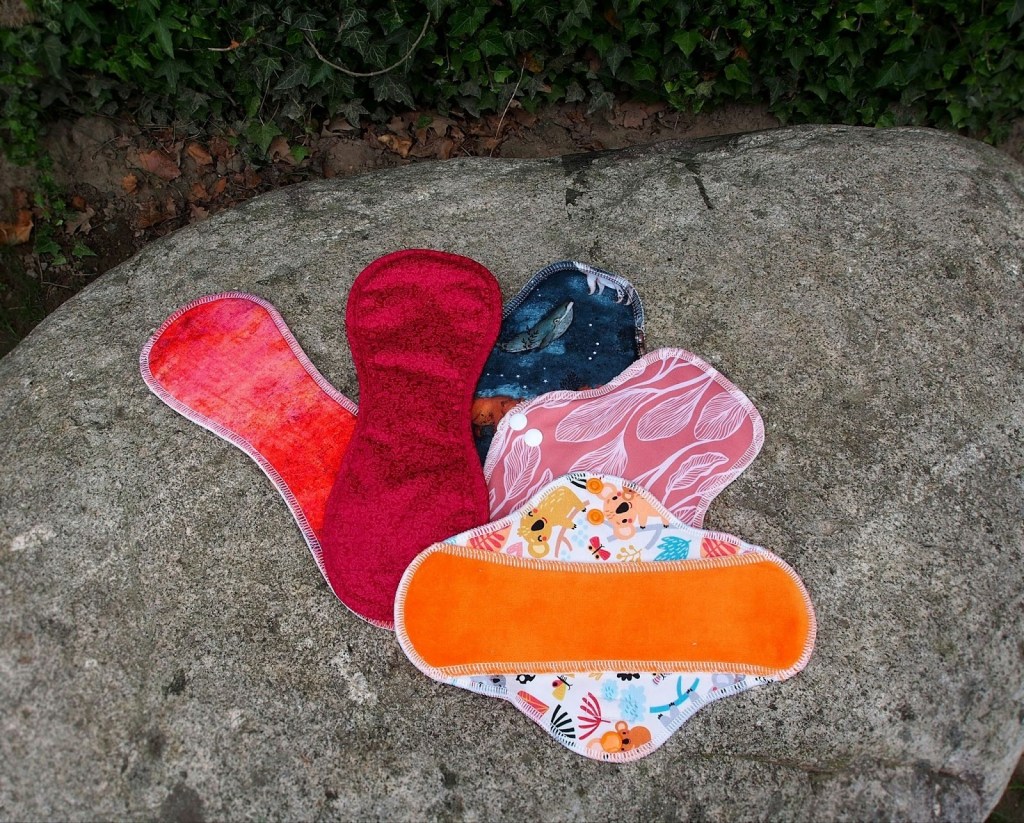
Photo by Šárka Hyková on Unsplash
What kind of solution are you working on to try and address these challenges?
Our proposed solution is a safe space menstrual health program, which is an eight week community-based learning program for girls and women in Kibera. We thought that this program should be hosted in local environments like schools, churches, mosques or community centres so the cost will be low, and it should be facilitated by local women. This programme in general combines menstrual health education with practical training in sewing reusable menstrual pads using locally sourced materials, so the cost will be low. By learning how to produce these reusable pads themselves, the participants gain access to affordable menstrual products – both for personal use, but also to get the opportunity to generate an income by selling these products in the community. And we try to remove the stigma, because during the program the girls and women can talk about menstrual health with each other.
And how did you come up with this solution, or who did you talk to?
We had several focus group interviews – we talked with young teenage girls between ages 13-16, and then we talked to mothers, adult women and community leaders as well. And they talked a lot about their issues and what they would like to focus on and their struggles, so that helped our group to narrow down what we should focus on. We also talked to teachers as well.
Is that where the idea to possibly do this in schools came from?
No, that’s because we were actually in a community meeting about sexual health, and that was in a school! So we thought, maybe our project could be similar, where people just show up and there’s one facilitator who shows everything and talks about everything. Maybe our case could be solved that way, using the facilities already in Kibera so the cost will remain low.
And when you are thinking about your case, your challenges and your solution: Where do you think there are limits or room for improvement? Maybe challenges you don’t know how to address yet or where you lack the resources to do so?
That we need to try and break the stigma. How will we make sure the girls and women show up to this learning program? We thought we’d try and fix this by teaching them how to make their own reusable pads so they could also sell that product. It would help to make sure that they keep coming back, because they feel that they’ve learned something, but they can also get an income that way.
And what about the general conditions? In the beginning you talked about how people might lack a safe public bathroom to change their pads in, or they might not have clean water. How are you thinking about these challenges and what did your focus group participants say about this – how do you think your solution will work in this context?
We think maybe we can have clean water during this 8-week program, at least to show them how to clean the pads. We also looked at a solution to clean with vinegar and salt, or other ways to clean the products. Also, I think we’re focusing on them being able to sew the pads, so if they can’t clean the pad right away they have another one they can use until the cleaning facilities are available.
That makes a lot of sense, I actually didn’t think about that! When you are reflecting on your experience with this project, what is the main thing you feel you learned as a person or a student?
I think I learned a lot! Especially the adult women were very open to talk about their issues and they were very engaged. They wanted to make sure their community could improve, therefore they really tried to contribute as much as they could with their answers. The younger girls were a bit shy, but they also opened up once we got our talk going. And I think that was really insightful: how we could combine their stories and experiences and try to make a solution for that, and how open-minded they really tried to be as well.
You just said the adult women and the girls acted a little bit differently in the focus groups – did you expect that?
I guess I expected it in some way, because when you’re a young teenage girl – obviously we’ve all been there – maybe you’re a bit shy to talk about a sensitive topic. They maybe don’t talk about this topic as much with each other, at least that’s the impression we got, while the adult women have a lot more experience and talk to each other about these topics. They are also mothers, so they have gotten education from some other organizations as well and are trying to teach their daughters, while getting more education themselves so they can be the best version of a mother to their girls.
So, something about the way people learn from each other and teach each other, exchange tricks they’ve learned or ideas that work for them. Interesting! Were there also some challenges you encountered?
We talked to a teacher as well and she told us some very difficult stories. Some girls, because they are desperate and men take advantage of them… there’s a thing called transactional sex, where they get a pad or clean water in exchange for sex. That was very difficult to hear, and the teacher got very emotional as well – our entire group got very emotional. But that was really difficult for us to hear and motivated us to think about how we can keep the younger girls safe and dignified. We really tried to focus on that and talked to our case expert as well, “How do we make sure they keep their dignity?” That was very challenging, to hear such difficult stories. You kind of feel helpless in that moment, to see and experience what others have to experience.
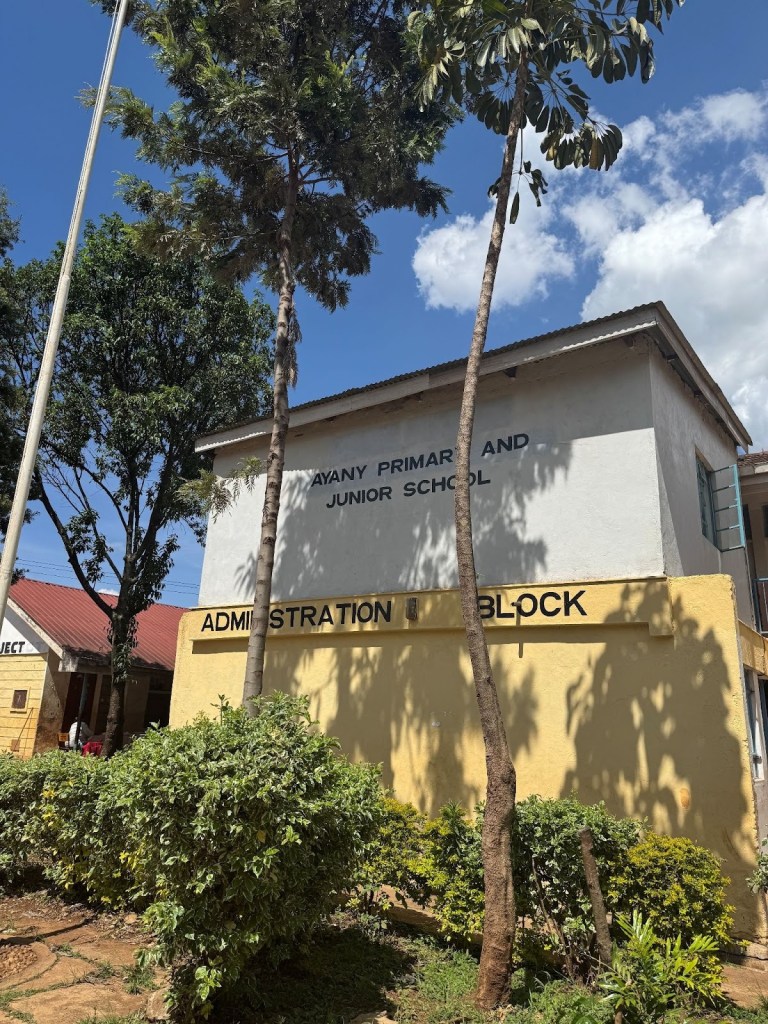
Image: Ayany Primary & Junior School, where focus groups were held with teenage girls
How would you see your own role in this whole project, or maybe your own wider role, now that you’ve learnt about these challenges that exist in Kibera? What do you feel is your role in addressing these, or what should it be, and why?
A… speaker role, kind of. I want to make sure that other people hear about this and I want to help as well, so a combination of these two. I want to do what I can do to help with our group – I hope our solution works – and just really show people that there is a need for this and that there are girls and women in Kibera who need much more help, and I think it’s important to pay attention to.
And who do you want to listen to in this process? You talked about the focus groups you’ve been part of. Who do you think should be part of this process of working on addressing a challenge that, as you said, has a lot of different facets? Economic issues, issues around stigma or education, around water and infrastructure… Who do you think should be a part of addressing this challenge? And who should perhaps be the one to lead the process?
There were community leaders in the focus groups as well, and I think they are a big part of this. There was one who really wanted to improve the community and listen to what we had to say, and she talked about her own story as well. I think it’s important to listen to people like her. And in general the focus groups are important, because these people are the ones living there, they are the ones experiencing that life, so I think it’s important to get all that knowledge and share it in the best possible way.
Thinking about going to Kibera for a school project and doing this innovation project: What do you think was the purpose of this project for you as a person?
I guess solving the menstrual health case. I think it’s really important to help girls who are vulnerable in the best way possible, by educating them, by empowering them. That was a big purpose for me.
Sort of a desire to help?
Yeah. Maybe to help and educate – but most importantly, listen to what they have to say and try to do something about it. Not just standing there on the sideline.
How did you feel you were received? What were people’s reactions to seeing you, as a group of students, come and offer your ideas?
I think they were very curious! They wanted to know what we’ve planned, what our process is and what we think could be a solution – in general just listen to what we had to say.
Then I’ll end with a little bit of a concluding question: Any experiences you want to highlight? Something that was rewarding or surprising for you? Or maybe something you are still thinking about?
We talked with the younger and teenage girls at a primary school in Kibera, and I think what was most rewarding for me was being in that environment. That was such a good experience. They were so welcoming and so happy to see us, it was a good experience overall. And I think that will stay with me, because I’m glad they wanted to share their stories and that they trusted us to try and help them in some way.
And if someone asked you if you would recommend doing this – say it’s ten years from now and you are sitting in the university administration. If you were asked about doing this kind of project again: would you or would you not? And what would you do differently?
100%, I definitely would do it again. I think what I’d do differently would maybe be staying there for a longer time or having more time with the locals. The focus groups, the community leaders, teachers…. Just having more time to process it all and making sure that they feel like their story is listened to. Because one woman told us that she was a bit sad that we had such a short time with them, and that really sat with me.



Leave a comment