Powering the Future, Exploiting the Present:
Lithium, the Green Transition & Environmental Justice
Collaboration with Green Youth Movement, Eye on Global Health and School of Global Health,
Special thanks to Global Development Network
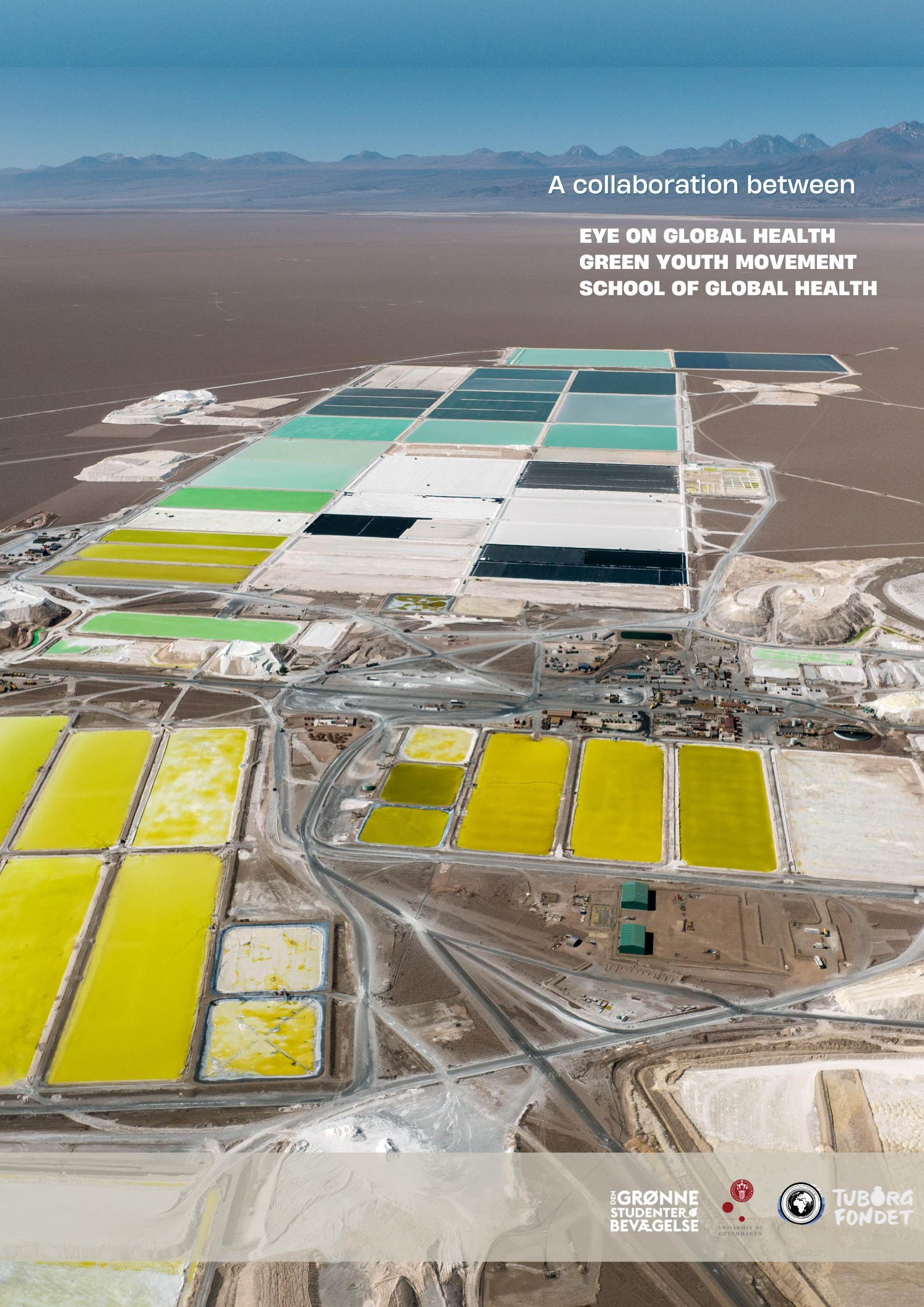
Join us for a night of discussions on the hidden costs of lithium mining—its impact on communities, health, and the environment in South America’s Lithium Triangle.
Sign up here
When/where?
Location: Ungdommens Demokrati hus / Youth Democracy House – Slagtehusgade 10a, 1715 København
Time: 23rd of April 17:00-19:00
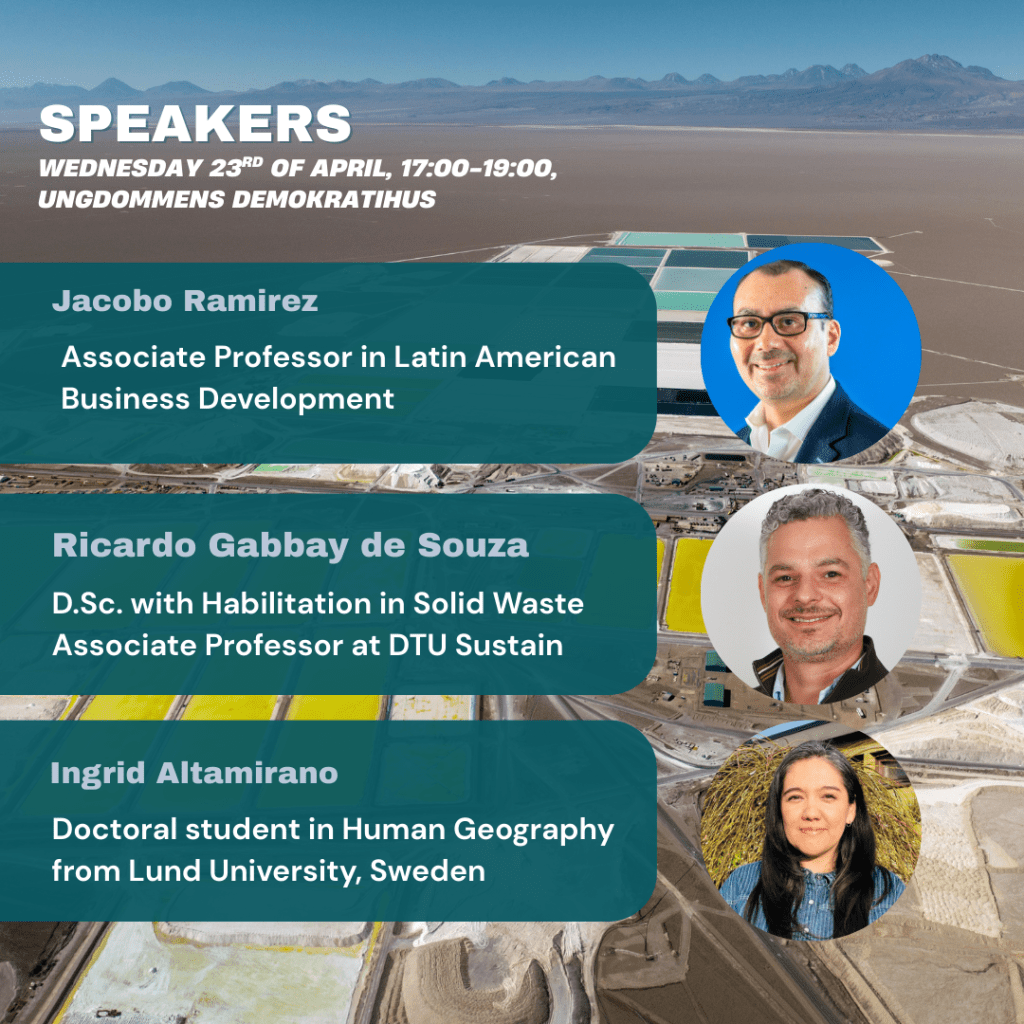
Speakers:
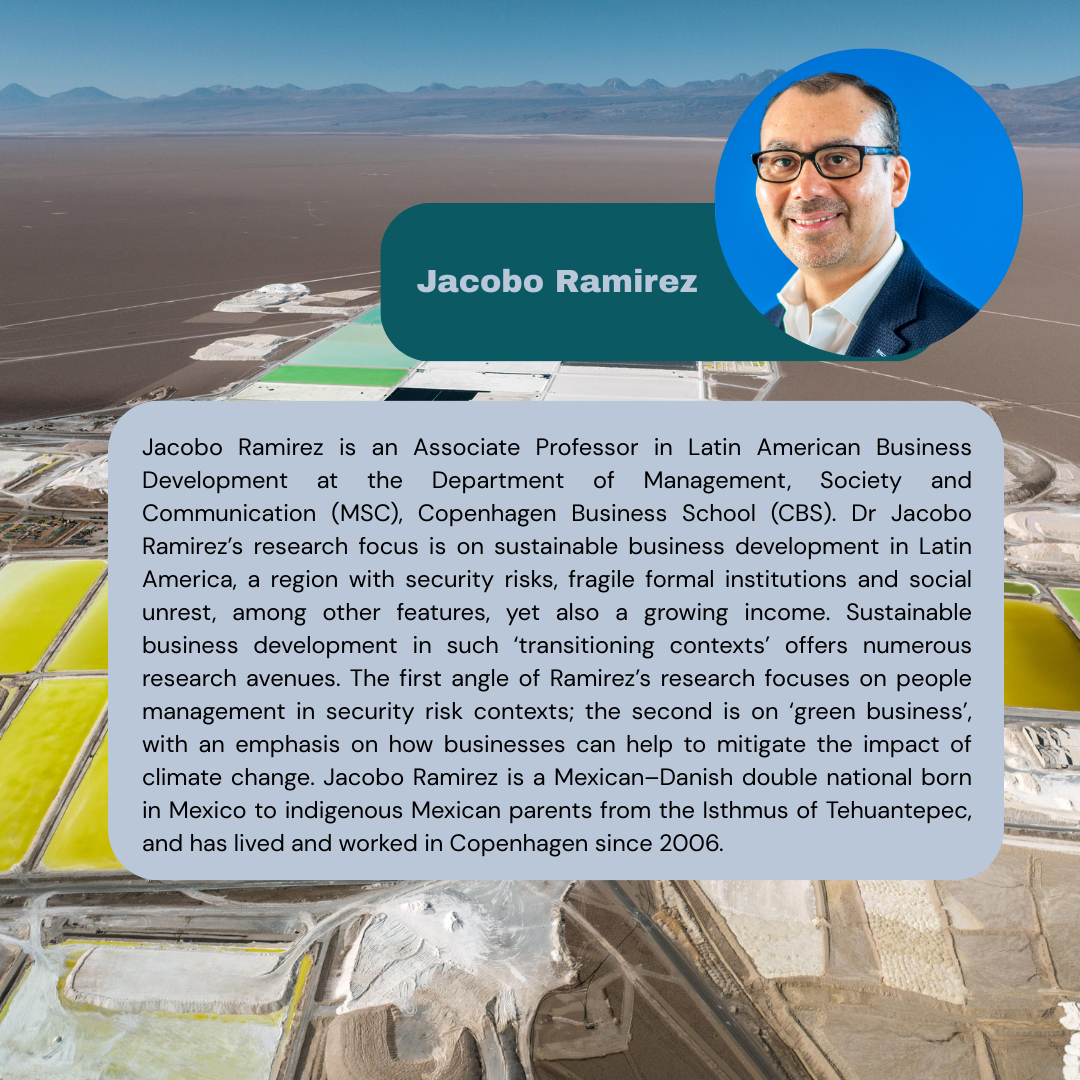
- Jacobo Ramirez, Associate Professor in Latin American Business Development
- Ricardo Gabbay de Souza, Associate Professor; Habilitation in Solid Waste
- Ingrid Altamirano,
Doctoral student within the TransFEM project
Description:
In this event, School of Global Health, Green Youth Movement and Eye on Global Health invite you to rethink the green transition: there is a high demand for lithium mined for greener energy, but at what cost? How much are local communities seeing any profits in their local economies? What health effects and environmental costs have lithium mining? Why are we sourcing this in a mostly untouched region, the now-called Lithium Triangle, of South America? And Why should we think about all of this here in Copenhagen?
Context:
Lithium mining, being the lifeline of the green transition, provides opportunities for greener energy and greener economies. However, when zooming into the local dynamics around lithium mining, social and systemic injustices are exposed, brought by neoliberalist ideologies and neocolonial tendencies, which establish power inequalities. Profits go to powerful corporate companies while local mineworkers are often left with the negative spillover effects of mining: health challenges and environmental pollution.
When discussing the challenges around lithium mining, we cannot just speak of water shortages, or environmental pollution as siloed problems that mine workers and the local population can be blamed for. Instead, there is a web of concepts that define how systemic inequality and injustice create on-the-ground power imbalances in access and opportunities, creating localised problems. Using a shift of lenses, we try to demonstrate the interconnectivity between climate change and the green transition, neocolonialism and health inequity, to showcase that these challenges can only be addressed when looking at the interconnectivity of problems at a systemic level.
About the Speakers: