By Bazlah Ali
How much can you really understand about a place in four weeks?
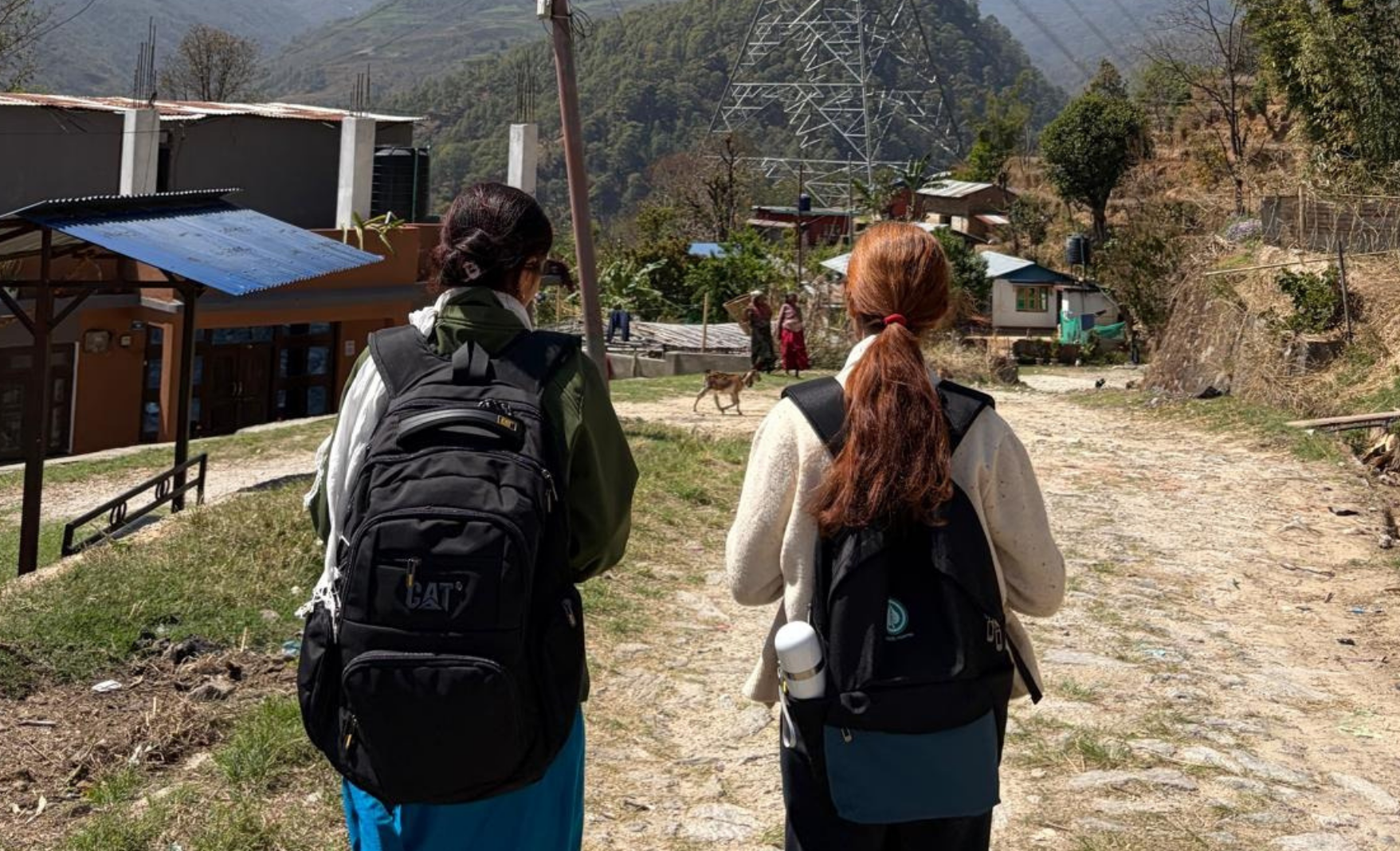
That question stayed with me throughout my month in Nepal as part of the University of Copenhagen’s Country Exposure Course. The course gives MSc Global Health students an opportunity to learn alongside local universities, researchers, and communities. For me, it was also about confronting the gap between what we discuss in the classroom and what global health actually looks like in practice, especially in resource-limited settings.
In Nepal, our group worked with researchers from Dhulikhel Hospital and Kathmandu University, visited healthcare facilities, engaged with local communities, and developed a concept note addressing a locally relevant health issue. Like my global health classmates, I arrived expecting to learn about a new healthcare system and a country known for diversity in terms of languages, cultures, and religions. What I didn’t expect was how often I would find myself questioning assumptions I hadn’t even realized I was carrying and reflecting upon my positionality.
As someone of Pakistani heritage, many aspects of day to day life in Nepal initially felt quite familiar; multigenerational households, labour migration, family involvement in decision-making and gendered expectations. I assumed this familiarity might help me better understand the communities we would engage with during my stay. In some ways it did. In many others, it did quite the opposite.
Our project was focused on exploring the role of family members in supporting women diagnosed with high-risk pregnancies. Our project built on an existing study called “Exploring the impact of digital health tools through a home-based monitoring app designed for high-risk pregnancies involving gestational diabetes and hypertension (MOM-HD).” We were interested in understanding how family members, particularly in-laws, might influence the use and uptake of the intervention. In many households, decisions related to pregnancy and healthcare are not made by individuals alone. They are shaped by family relationships, expectations, and support systems. The idea behind our concept note was to explore these dynamics and consider how future versions of the intervention could meaningfully engage family members rather than focusing solely on the pregnant woman herself.
At first, our work felt relatively straightforward. We identified what we believed was an important gap in the existing research: the role of in-laws in supporting or influencing the management of high-risk pregnancies.
But as the weeks went on, I began to wonder whether this was truly a gap in practice, or simply a gap in academic literature.
The role of in-laws in pregnancy is hardly a new phenomenon in South Asia. While it may not be extensively documented in research, it is likely something that families, healthcare providers, and communities already understand well. This realization made me think more critically about how global health research often defines what is worth studying. Sometimes the things we identify as “new” are only new within academia, not within the communities themselves.
Another assumption I carried with me surfaced during our visits to rural households.
Having spent time in rural areas of Pakistan, I arrived with certain expectations about the socioeconomic circumstances we might encounter. Instead, many of the families we met lived in large homes, owned land, and kept livestock. While this certainly did not mean they were free from financial challenges, it reminded me how easily we can use experiences from one context to make assumptions about another.
The familiarity I expected sometimes made me overlook important differences between the two contexts.
One conversation that stayed with me was with a woman whose husband was working abroad in Dubai as a taxi driver. Coming from a family that migrated from Pakistan to Canada, I had always associated leaving a low- or middle-income country with better opportunities, higher salaries, and an improved quality of life. Migration was something I had generally viewed as desirable. I asked her if she and her kids had future plans to eventually move to Dubai to be with her husband.
I was surprised when she told me that she had no interest in moving abroad and preferred to remain in her community, even if that meant living with her in-laws while her husband was away.
It was a simple conversation, but it challenged an assumption I had not examined very closely before: that what I considered a better opportunity would be valued the same way by everyone else. Her perspective reminded me that decisions about migration are not driven solely by economics. Family, a sense of belonging, community, and personal preference matter too.
Another interaction that has stayed with me was with an 18-year-old pregnant woman whose husband was also working abroad. She lived with her mother-in-law and worked full-time collecting microfinance payments door-to-door. There was a significant language barrier, but during our interview, she answered our questions politely and positively. Yet after the conversation ended, I found myself thinking about everything I still didn’t know.
How did she truly feel about being pregnant while living away from her own family? Did she experience her living situation as supportive, restrictive, or something in between? How did she actually feel about working such a challenging job while being pregnant?
These were not questions we could realistically ask. There were seven foreign students present, limited time, language barriers, and the interview itself was completely unplanned. Looking back, I am not sure our conversation captured her experience so much as it captured what could be expressed under those circumstances.
What stayed with me afterwards wasn’t what she told us but everything that remained unspoken.
That experience made me think differently about the kinds of knowledge we produce in global health. Interviews, surveys, and focus groups are valuable tools, but I think they only provide a partial picture. Some aspects of people’s lives cannot be fully understood through a handful of questions asked by visitors passing through.
Alongside the research component of the course, I also had the opportunity to deliver a lecture to nursing students at Kathmandu University and tour several departments within Dhulikhel Hospital. As a neonatal intensive care nurse from Toronto, these experiences offered an alternate lens on the healthcare system.
I found myself constantly comparing practices, governance, resources, and infrastructure between settings. While some differences were immediately visible, others were more subtle. The experience reinforced something I often return to in global health discussions: improving health outcomes is not simply about introducing new interventions. It also requires understanding the realities of the environments in which care is delivered and the constraints healthcare workers navigate every day.
When I think back on my month in Nepal, I think about the assumptions (some obvious, others hidden) that were challenged along the way.
This experience left me with more questions than answers, and perhaps that is part of the value of these opportunities. Not because uncertainty is the goal, but because recognizing the limits of our own understanding is often where deeper learning begins.
References:
Ministry of Health and Population. (2026). Ministry of Health and Population, Government of Nepal. Retrieved August 29, 2026, from https://mohp.gov.np/
Public Health Update. (2026). Organogram of Nepalese health systems. Retrieved August 29, 2026, from https://publichealthupdate.com/healthsystem/
Rutgers, The State University of New Jersey. (2026, July 29). Mobile-based obstetric monitoring for pregnancies complicated by hypertension and/or diabetes (MOM-HD) (ClinicalTrials.gov Identifier NCT07243886). ClinicalTrials.gov. https://clinicaltrials.gov/study/NCT07243886
University of Copenhagen. (2025). SGLK20004U: Country exposure—2025/2026. https://kurser.ku.dk/course/SGLK20004U/2025-2026
Bazlah Ali is an MSc Global Health Student at the University of Copenhagen and Registered Nurse from Toronto, Canada, with a background in neonatal intensive care and healthcare consulting. Her interests lie in maternal and child health, health equity, and understanding how social and structural factors shape health outcomes.


Leave a comment